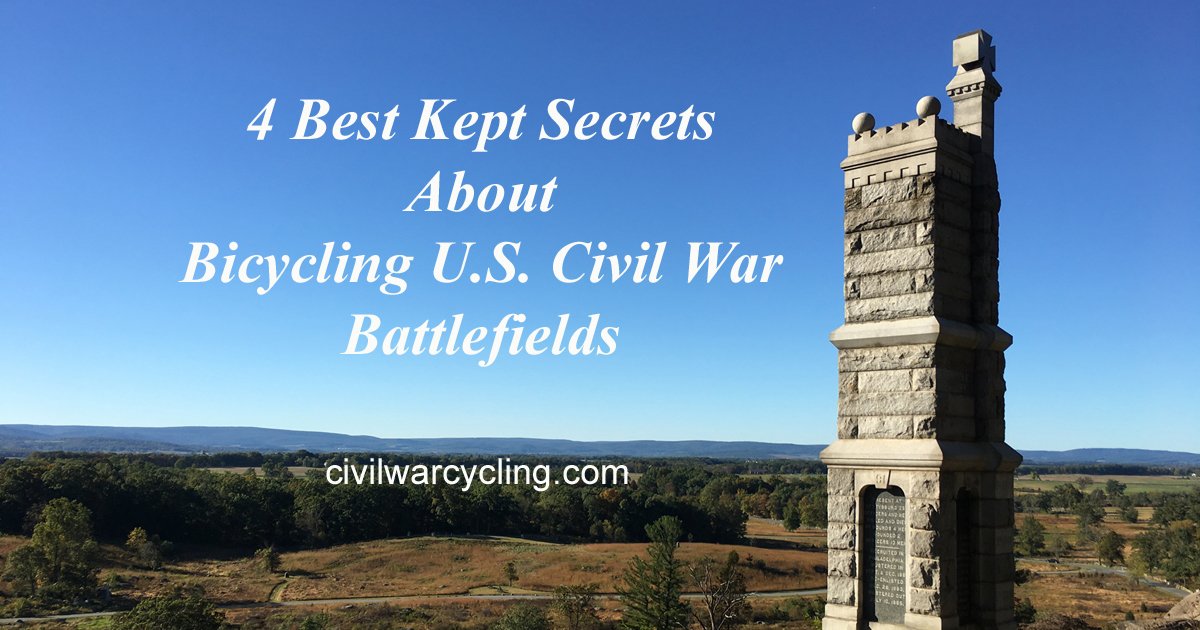
I surprise and confuse many people when I say this: Bicycling a U.S. military park is not only a real possibility, but with planning it can be a fun and safe educational adventure. In this blog post, I spill-the-beans and then suggest that we “follow the money” to understand the four best kept secrets about bicycling battlefields in the United States.

Best Kept Secrets About Bicycling Battlefields
I grew up about fifty miles south of Gettysburg, in what was then rural Maryland. Gettysburg was a favorite family destination for historical touring and camping. But we never thought about bicycling the battlefield. Since 2012, however, I have bicycled Gettysburg National Military Park dozens of times. After every trip, I feel renewed and grateful for the opportunity to ride freely, to learn freely, and to enjoy my day however I want.
Best Kept Secret #4
Bicyclists have easier access to park monuments and interpretive signs than is possible for tourists in motor vehicles.
This point may sound obvious. On the other hand, the first time you experience how easy it is to glide your bicycle over to a grassy shoulder, hop-off, and then do whatever you want — read, study, admire a sculpture, enjoy the view, or drink some water — you will be grateful not to be an auto tourist.
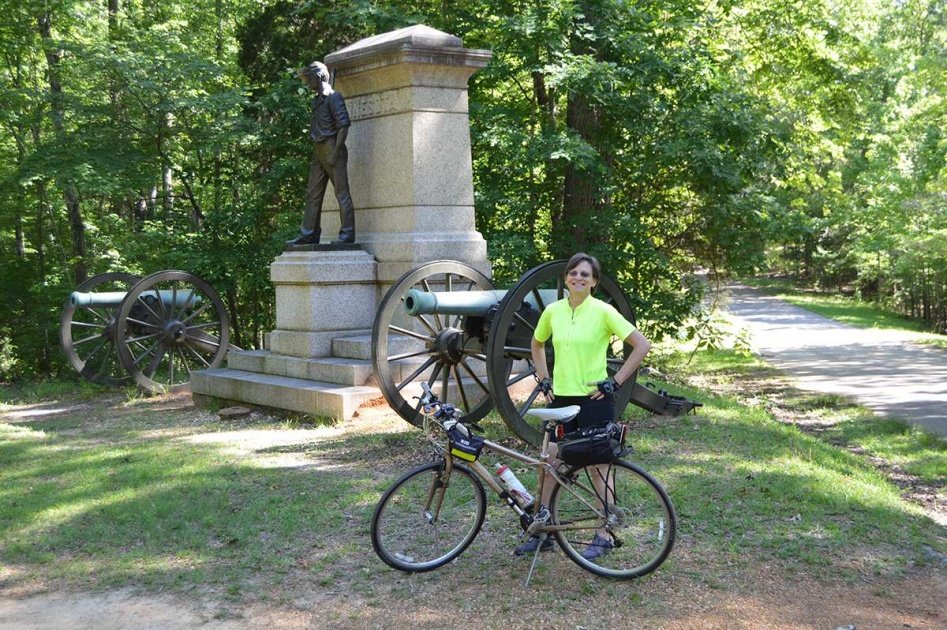
There is a place, of course, for auto tours. Over the decades, I have enjoyed many car and bus tours. I am the first to admit that on a hot summer day an air-conditioned car is a great relief. But on the downside, I am not breathing fresh air. Windows separate me and my camera from a beautiful landscape.For me, the biggest hassle of touring in a car is that I am limited in the number of stops that I will want to make. The limit is self-imposed: I get annoyed having to find a parking space, turn off the engine, get out of the car, decide whether to lock my doors (and where to put my keys), and then repeat the whole thing in reverse — over and over again.
Here is the fourth in my list of secrets about bicycling battlefields:
If you are healthy enough to ride a bicycle at the pace of your own choosing, and humble enough to walk your bicycle up a few hills, then bicycling Gettysburg National Military Park is definitely an option worth considering.
Best Kept Secret #3
Bicyclists experience in their bodies the historic significance of battlefield hills, fields, woods, and streams.
This point may seem abstract. Let me put it this way: A bicyclist who is pedaling up Sykes Avenue to the top of Little Round Top (Gettysburg) feels strain in her legs and hips. Even in first gear, I huff and puff. I have doubts that I will make it to the top without having to walk my bicycle. Half the time, I walk the hill.

Having experienced the steepness of that hill, a bicycling historian has a physical appreciation for the efforts of Union and Confederate soldiers who fought there on July 2, 1863. As I pedal to the top of Little Round Top, I am aware that men from Texas and Alabama tried several times to scale the hill from my right-rear (southeast) and that men from Maine repulsed them from my right-front (northeast).
And of course, what goes up must come down! Gettysburg offers several small and large hills that offer a pleasant and invigorating downward ride — Little Round Top, Culp’s Hill, Oak Hill, and even the gentle decline of Seminary Ridge.
Here is the third in my list of secrets about bicycling battlefields:
If you really want to learn history, there is no substitute for physically visiting a historical site. And the more actively you engage your senses, the more likely you will understand and remember the significance of the historical event.
Best Kept Secret #2
Bicyclists exercise their own self-determination and confidence by planning their own educational experiences.
Personally, I prefer to make my own decisions about what I learn and how and when. I probably got that way because I went to school for longer than most people. As a student, I tried to do everything that I was told to do. On the other hand, you may prefer the help of a licensed guide. The right way is whatever works for you.

Here is the second in my list of secrets about bicycling battlefields:
Unless you live within an easy car ride of Gettysburg, bicycle touring requires some upfront planning. A bicyclist will need to decide ahead of time what Gettysburg sites or monuments to visit and why. This is so that the trip can be as fun and educational as possible in that time that you have available. For independent-minded people, the planning step is also fun!
Best Kept Secret #1
Bicyclists celebrate their freedom and independence without needing to spend a lot of money.
Your biggest expense as a bicyclist touring a U.S. national military park is what you would expect of any vacation: transportation and lodging. If you do not already own a bicycle, you can rent one for the day. On a bicycle, food and water is no more expensive than packing a lunch for school or work.
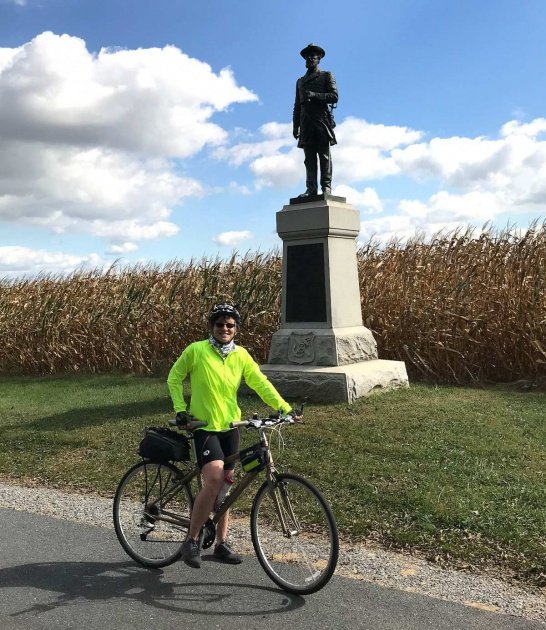
Bicyclists who tour U.S. Civil War battlefields help boost the local economy with their tourist dollars. But spending money is not our primary focus. For example, when I ride through Gettysburg National Military Park, there are no souvenir shops, book stores, or restaurants. I am my own tour guide. The museum and visitor center may be miles away.
In fairness, the National Park Service encourages tourists to enjoy fully the natural resources that it maintains and preserves as park land. My point is that you may not hear much about bicycling a U.S. national military park, partly because historical bicycling is not a big part of the tourism industry. …. And bicyclists like it that way!