I begin with a personal comment: My interest in American Civil War history accelerated after my kids grew up. I like to think it’s because I started to have more time to read and reflect. Truthfully, though, that wasn’t it. In this blog post, I offer three common reasons why you think you cannot learn history (and how to fix it).
3 Common Reasons Why You Think You Cannot Learn History (And How to Fix It)
Adult learners are responsible for their own learning. That’s the theme here. And it ties together the three reasons why you think you cannot learn history, which we outline below.
On the downside, it means that if we don’t choose to have fun, or to find relevance and meaning, then we won’t. Period. Your choice.
On the upside, it means that you are free to learn whatever you want, however you want, for whatever purpose that you want. It’s a free choice.
1. You cannot imagine that history could be fun.
History may not have been fun in school, so how could it be fun now? I confess, I once thought that way. Looking back, I have only a handful of memories about learning history in a classroom setting. I enjoyed studying history when I had an opportunity to research my own topic, draw my own picture, or go on a field trip. Unfortunately, those types of fun experiences were more the exception than the rule.

Beyond some isolated experiences, I could not imagine that history could be fun. After all, what’s so fun about listening to Mr. McCreary bang his wooden yardstick against a dark oak podium whenever he sensed that we had tuned him out? We were supposed to be learning American History, but from my perspective as a ninth-grade girl, we were being forced to memorize the same things that we had to memorize in elementary school. Never mind that I couldn’t remember any of that. Not fun.
Okay, now, lest you think I was a poor student, I wasn’t. I was the valedictorian of my high school class. And I hated history, because it was boring. Or so I thought then. I did not know that history could be fun. To me, American history was just another subject outlined in white chalk on a blackboard.
How to Have Fun Learning History
If you have visited even one page of the Civil War Cycling website, you won’t be surprised that I propose the following remedy. Admittedly, it’s only one remedy among many good ones, but you might like it the best:
Explore historical sites on a bicycle! U.S. national military parks offer an awesome opportunity to have fun pedaling around and finding things to study, read, or experience.
For more ideas on this topic, please consider reading my post, Decoding a Complex Battlefield Story – Shifting Your Mental Gears on a Bicycle. If bicycling is not feasible for you, perhaps you can find another way to tour — walking, driving a car, riding a bus.
Honestly, I don’t know that there is any adequate substitute for physically visiting a historic site. Bike it, walk it, drive it. Something!
2. You cannot see yourself as part of the story.
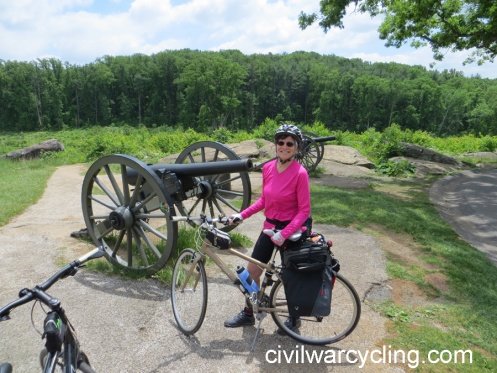
The second reason why you think you cannot learn history is that you cannot see yourself as part of the story. And in that case…
…it is hard to care. We want what we learn to be relevant to our lives.
If on a personal level the historical relevance or meaning is not immediately obvious, well then, we have work to do. But of course, we must want to work and want to learn. That’s a lot of preconditions. They can be big obstacles to overcome.
All this begs the question: Aside from serious goal-setting and traditional study, how can we see ourselves as part of a battlefield story?
How to Feel Part of the Story
In my experience, many women have a hard time even wanting to figure out how their own individual stories fit into a 19th century battlefield narrative. I’ve been one of those women. I just don’t relate to histories filled with military jargon and preoccupied with military maneuvers. I never felt like I was getting the whole story. Most certainly, I could not imagine myself being in the story.
At the risk of your noticing that I am repeating myself, I started feeling part of the story when I started to tour historic sites. In my opinion, the U.S. National Park Service has done a tremendous job highlighting the Civil War Era experiences of our broad and diverse population. The story includes women, children, citizens, African Americans, and European immigrants.
In our national parks, we can learn with our bodies and we can learn with our minds…
Learning With Your Body

In a bicycling blog, it is no surprise that we focus on bicycle touring. A bicyclist enjoys a visceral experience of history while touring a national military park. A bicyclist uses his or her body to learn. We may not always understand exactly what we are learning, but we feel part of the story nevertheless.
For a deeper explanation, please see my post, 4 Best Kept Secrets About Bicycling Battlefields, where I describe how bicyclists experience in their bodies the historic significance of battlefield hills, fields, woods, and streams.
Learning With Your Mind
Of course, it’s also good to use our minds. While touring a battlefield, bring a history book that describes not only the actions of soldiers, but the actions of citizens and the impact of the battle on the town and nation. For some ideas on what to read, please see these my Civil War Cycling pages: Civil War Reading Recommendations or Gettysburg Reading Recommendations.
3. You were taught history as a long series of disconnected facts.
In the United States, this is a common complaint about history — that it is a long series of facts to memorize. It’s like a jumble of puzzle pieces that are never assembled into a meaningful picture.
Adults sometimes think that they cannot learn history, because they could not learn it in the past. Really good students may have learned it well enough to get an ‘A’ on a test, but that knowledge quickly disappeared.
The third reason why you think you cannot learn history is that you have not found a way that works for you. Sometimes, it feels like a Catch-22: To understand a theme, you need to know some facts; but the more facts that you know, the harder it can be to find a theme.
How to Discern Meaning in the Story
If you want to move beyond a mind-numbing catalog of facts and figures, I recommend that you start with a thematic book. For example, if you are interested in the Battle of Gettysburg, why not start with MacKinlay Kantor’s highly acclaimed book, Gettysburg? (For a review, please see: Simplest Ever Introduction to Gettysburg – Book Recommendation.)
Wrap-Up – Why You Think You Cannot Learn History
I offered three reasons why you think you cannot learn history, but there are probably many more. In the end, you are the only one who knows for you. The question is whether you want to take the next step. Do you want to have fun learning? And do you want your education to be relevant to your life? What about meaningful learning?
It’s up to you. For me, I found all of that and more on a bicycle.