Test your knowledge about Gettysburg Confederate state monuments with these interactive quizzes. Even if you know very little, this is an easy way to learn a lot. After all, there are only eleven Confederate state monuments at Gettysburg, so you will master this material quickly.
Gettysburg Confederate State Monuments
This post contains two short, anonymous quizzes and an invitation to take a deeper dive at the end. It doesn’t matter whether you answer all of the questions correctly on your first try or whether it takes multiple tries.
Beginner Quiz – What State Monument?
This isn’t a traditional quiz, because you only need to think about a question and think about a one-word answer. Easy!
Instructions: First, study each photo and think about what Union state it might represent. Then hover over the photo and read its caption. (On a mobile device, lightly touch and hold the image). If you want to enlarge the image, simply click the photo.
Look carefully at the photos and guess the state.
Answers: The answers are in the photo captions, above.
Intermediate Quiz – Know Your Confederate States
Here is an accordion-style quiz. Remember, it’s not about knowing the answer. It’s about learning something new.
Instructions: Read the question, think whether you might know the answer, and regardless, click on the question to uncover the answer.
Tip: There are eleven Confederate state monuments at Gettysburg National Military Park: Alabama, Arkansas, Florida, Georgia, Louisiana, Mississippi, North Carolina, South Carolina, Tennessee, Texas, and Virginia.
Answers: The answers are below the questions.
Advanced Exploration – Curious to Know More?
Instructions: Follow the next link to an article that contains photographs, a short history, another interactive quiz, and a scavenger hunt with a map.
Sometimes, it helps to drill the basics. This post provides a safe place to click around and learn without having to worry about a teacher grading your performance. Here, you are your own teacher! Civil War Cycling simply offers you tools to use.
On the other hand, it’s no fun for drilling to be your only approach to learning. That’s why we also bicycle battlefields, enjoy photos, have conversations, read books, and tour museums!
Why do people visit Soldiers’ National Cemetery? How does Soldiers’ National Cemetery draw patriots to Gettysburg? … I think you need to feel it, hear it, or touch it to understand.
Soldiers’ National Cemetery Draws Patriots to Gettysburg
For taps…
Check out this May 12 article in the Hanover (PA) Evening Sun that reports that“One Hundred Nights of Taps” is coming to Gettysburg beginning on Memorial Day, 2017. Even if you cannot make it to Gettysburg this spring or summer, please consider listening to the video in which Navy Lt. Joshua Corney explains why he plays taps.
For beauty…
Here is a Civil War Cycling article that includes a photo essay and a brief history of the national military cemetery at Gettysburg. The cemetery rests between Taneytown Road and Baltimore Pike. It also shares a common border with the town’s Evergreen Cemetery, where Civil War civilians are buried.
Click on the image to go to our photo gallery.
No trip to Gettysburg is complete without visiting Soldiers’ National Cemetery. So park your bike and walk the cemetery. You may find that early morning and dusk are the best times to visit, mostly for the serenity that embraces those quiet hours.
Tomorrow is Memorial Day. If you cannot visit a military cemetery or grave, please consider what you can do online to remember our deceased veterans.
You might also enjoy these Civil War Cycling articles…
The National Park Service offers a free, downloadable PDF brochure (“National Cemetery Walking Tour”). Although bicycles are not allowed in the cemetery for obvious reasons, as of this writing the National Park Service offers two bicycle racks, one at each entrance. Another option is to lock your bicycle in your car parked at the National Cemetery Parking Lot on Taneytown Road.
In anticipation of Memorial Day, today’s post is about my experience bicycling Culp’s Hill in Gettysburg National Military Park. For me, battlefield bicycling ignites a “new burst of freedom” (a play on President Lincoln’s words) that draws inspiration from the sacrifice of our veterans, living and dead. First, though, an admission. I struggle to find words that explain my personal opinion:
Bicycling historians experience in our bodies the freedom won on the battlefield. In other words, the bodily experience of bicycling a U.S. Civil War battlefield is a celebration of personal and civic freedom.
That’s about as succinct as I can say it, but the words sound so — what word should I use? — patriotic? profound? hollow? uppity? fake? naive? obvious? true? Nevertheless, the words capture how I feel.
In this post, perhaps the best I can do is to run with those two sentences; add some photos; and mix-in a few paragraphs laced with words that connote sweat, grime, gusty breezes, and stinging heat. … and gratitude! Gratitude for the freedom to ride where I choose, how I choose, and with whom I choose.
Memorial Day – A Bicyclist’s Perspective
On Memorial Day, we remember and honor our military men and women who have died in service of our country. I remember them every time I bicycle Gettysburg National Military Park. And for me, there is no greater example of a liberating ride than pedaling hard up Culp’s Hill and then flying down so fast that it’s really wise to tap your brakes at least a little. The wind is so strong against my ears that I can only hear its roar. The wind gives extra meaning to the phrase, “new burst of freedom.”
The above photos hint at the the beauty of Culp’s Hill, but it may not be obvious what an awesome ride it offers to bicyclists. Frankly, I cannot give up this fast, thrilling ride for the idea of stopping to snap photos. And even if I did, you would really need a video recording to understand the thrill.
Pedaling up the hill along Slocum Avenue is another matter entirely. Even though it is a tree-lined road, in the summer the pavement is dreadfully hot. I will jump at any excuse to sit on a rock and enjoy a juicy apple. I don’t mind mixing sweaty palms with sticky apple juices, because I have a warm but wet washcloth in my panniers. And I am 100-percent sure that I am fortunate not to have been a soldier fighting on this steep hill.
A New Burst of Freedom on a Bicycle
When I write about a new burst of freedom, I am hinting at the physical experience of bicycling up and down hills — or suddenly changing one’s speed. I like to write about a new “burst” of freedom as play-on-words that recalls these sentences from President Abraham Lincoln’s Gettysburg Address on November 19, 1863:
… that we here highly resolve that these dead shall not have died in vain — that this nation, under God, shall have a new birth of freedom — and that government of the people, by the people, for the people, shall not perish from the earth.
In one sense, of course, my words could be received as a trivialization of the meaning of the Battle of Gettysburg. That is not my intent. I am only suggesting that sometimes it’s the little things in life that are the biggest expression of virtue and gratitude. President Lincoln’s 272-word address to the nation might just be the best example of oratory simplicity. Ever. Me on the other hand, all I can do is bicycle. And experience a new burst of freedom.
Where is Culp’s Hill?
Culp’s Hill is less than one mile southeast of downtown Gettysburg. According to the United States Geological Survey, it stands at 629 feet MSL (Mean Sea Level). By contrast, nearby Cemetery Hill is 616 feet MSL. On July 2-3, 1863, the Union line extended from Culp’s Hill (its right flank), west and around Cemetery Hill, and then south along Cemetery Ridge to Little Round Top (649 feet MSL), which is about two miles from Culp’s Hill.
The bicyclist experiences these modest hills as short and steep ascents followed by great downhill bursts. The ride from the south end of Slocum Avenue (at Spangler’s Spring) to the summit of Culp’s Hill is a 0.8 miles climb with very little relief unless one takes a break to look at the many regimental monuments that line the park roadway. The ride down Slocum Avenue to Stevens’ Knoll (at the intersection of Slocum and Wainwright Avenues) is a quick 0.2 miles. I wish this “new burst of freedom” were longer, because it’s over in a jiffy.
The Battle for Culp’s Hill
Slocum Avenue is named after Union Maj. Gen. Henry W. Slocum (1827–94), commander of the 12th Corps, Army of the Potomac. The park avenue marks the approximate position of the Union battle line. This was the Union right flank on July 2-3, 1863, when Confederates attacked from the north and west, roughly from positions marked by modern-day E. Confederate Avenue.
The fighting on Culp’s Hill was intense. The oldest Union general at Gettysburg, Brig. Gen. George S. Greene (1801–99), ordered his brigade to create earthen breastworks to hold the Confederates in check. The sixty-two-year-old former civil engineering instructor from West Point and his men in Slocum’s 12th Corps held the high ground for the duration of the Battle of Gettysburg. In 1907, a monument honoring Greene (by sculptor R. Hinton Perry) was dedicated at the top of Culp’s Hill, not far from the Observation Tower.
The Ride Down from the Summit
View from the base of Culp’s Hill Observation Tower, before your ride down.
Bottoming Out at the Knoll
View from the base of Culp’s Hill, near the end of your ride down.
Why Does It Matter?
Lincoln addressed a crowd of 15,000-20,000 people at the dedication ceremony for Soldiers’ National Cemetery in Gettysburg. Although the Gettysburg Address is not directly associated with Memorial Day, his words continue to explain for generations of Americans why it matters:
The Gettysburg Address
Four score and seven years ago our fathers brought forth on this continent, a new nation, conceived in Liberty, and dedicated to the proposition that all men are created equal.
Now we are engaged in a great civil war, testing whether that nation, or any nation so conceived and so dedicated, can long endure. We are met on a great battle-field of that war. We have come to dedicate a portion of that field, as a final resting place for those who here gave their lives that that nation might live. It is altogether fitting and proper that we should do this.
But, in a larger sense, we can not dedicate — we can not consecrate — we can not hallow — this ground. The brave men, living and dead — who struggled here, have consecrated it far above our poor power to add or detract. The world will little note, nor long remember what we say here, but it can never forget what they did here. It is for us the living, rather, to be dedicated here to the unfinished work which they who fought here have thus far so nobly advanced. It is rather for us to be here dedicated to the great task remaining before us—that from these honored dead we take increased devotion to that cause for which they gave the last full measure of devotion — that we here highly resolve that these dead shall not have died in vain — that this nation, under God, shall have a new birth of freedom — and that government of the people, by the people, for the people, shall not perish from the earth.
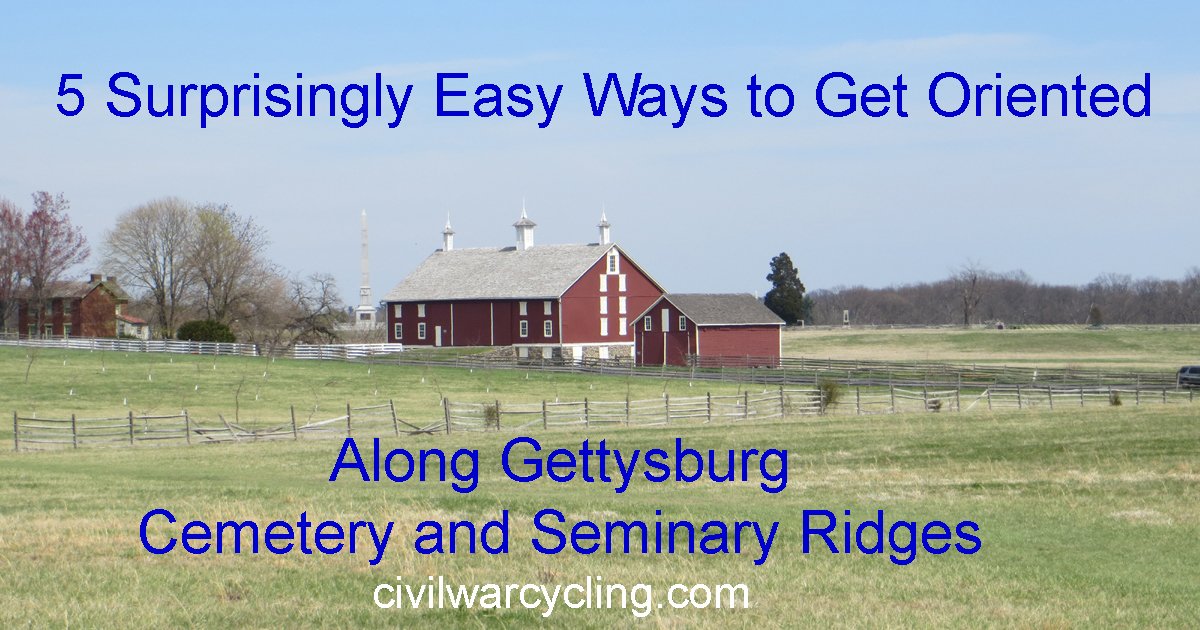
My ears perk-up whenever I overhear a battlefield guide talk about natural and physical landmarks. That’s because it is very helpful to know where I am standing in relationship to the hills, woods, monuments and buildings that I see in the distance. In this post,you will learn how to get oriented along Gettysburg Cemetery and Seminary Ridges, using as reference points four Union monuments and one famous barn.
5 Surprisingly Easy Ways to Get Oriented Along Gettysburg Cemetery and Seminary Ridges
Looking North from Hancock Avenue on Cemetery Ridge
These quizzes are designed for beginners. You can go from knowing very little to knowing a lot with very little effort. Quickly master the 5 easy ways to get oriented along Gettysburg Cemetery and Seminary Ridges by playing with our Beginner Quiz, Intermediate Quiz, and then following the link to a photo-packed article on the subject.
Looking West from Cemetery Ridge Toward Seminary Ridge
Beginner Quiz – What Are These 5 Landmarks?
Instructions: First, study each photograph and think about this question: What is the name of the landmark?
Answers: Hover over each image to read its caption (or on a mobile device, lightly touch and hold the image).
Intermediate Quiz – Know Your Compass Rose
Instructions: Read the question, consult the map, and then click on the question to uncover the answer.
Answers: Look under the question! Questions and answers are formatted accordion-style to make it easy for you to cheat! Go for it. No one is watching.
Gettysburg July 2, 1863 – Places to Know
Questions:
Advanced Exploration – and Answers!
Click Me
Click the star for answers to your questions. You will find a photo-packed article that summarizes the most important orienteering tips covered by today’s quizzes. The article contains a map that pinpoints the location of each monument.
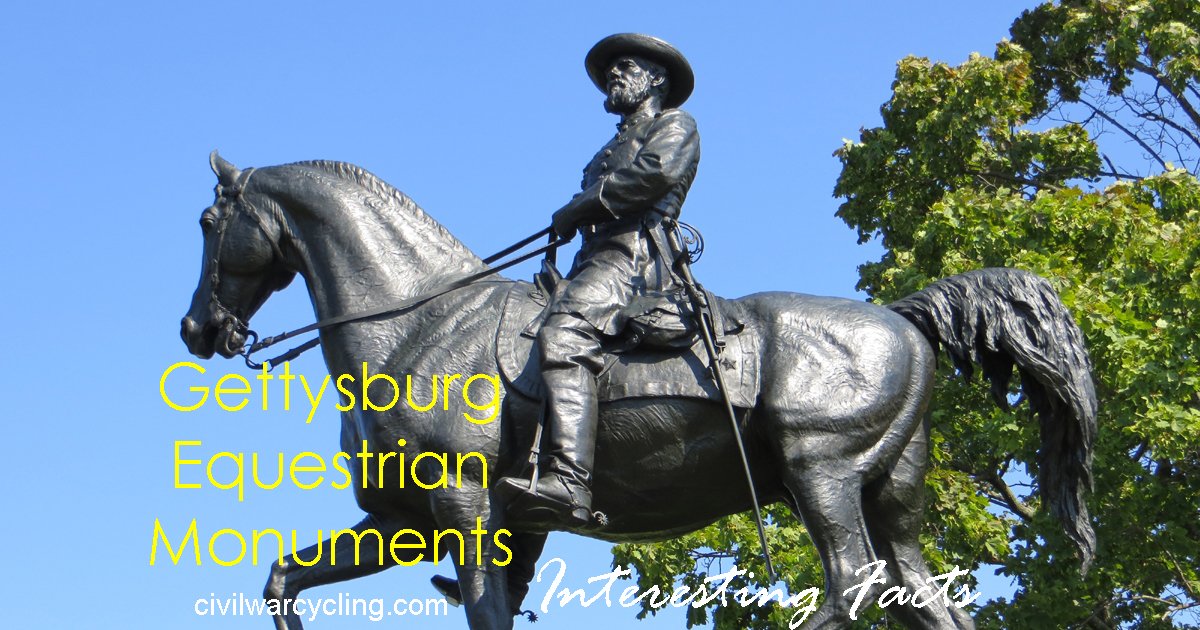
There are eight Gettysburg equestrian monuments. Can you identify which is which? What about their riders, do you know their names? Let’s have a little fun. The monuments listed in the following table are ordered for convenience designing a bicycling loop through Gettysburg National Military Park. To get started with your planning, visit these pages:
Every history lover has their own unique answers to why one might want to visit or study historic monuments. Some reasons are obvious or predictable; others, less so. For example, I wonder how many people can identify with my interest of combining hobbies (photography, history, art) into one bodily experience on a bicycle. See below for my thoughts on this…
Do you like to collect? categorize? explore?
Some people love to collect and organize or categorize things. Maybe not things, but ideas. You might think that such people are well-suited for office or library work. And that may be true. I am one of those people. We are geeks.
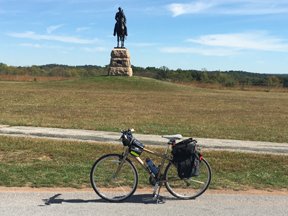
Parked in front of the Meade Equestrian Monument, Hancock Avenue, Gettysburg
But some people are athletic geeks. When I discovered that I can collect (and later categorize) photos while bicycling historical sites, that was a happy day! What is more, if I plan ahead and know, for example, that there are eight equestrian monuments at Gettysburg National Military Park, I can use that knowledge to plan a circuit through the park for visiting each of the eight monuments. And while I’m there, I can read and study a little American History.
Please consider clicking into the photo menu near the top of this post. If you are a visual learner with a modicum of interest in the Battle of Gettysburg, I think you will enjoy experience.
Today, a challenge: Test your knowledge about Gettysburg Union state monuments with these interactive quizzes. Even if you know very little, this is an easy way to learn a lot. After all, there are only seven Union state monuments at Gettysburg, so your chances of mastering this material quickly are very good. You will learn something about each of the following state monuments: Delaware, Indiana, Kentucky, Maryland, New York, Pennsylvania, and Vermont.
Gettysburg Union State Monuments
This post contains two short, anonymous quizzes and an invitation to take a deeper dive at the end. It doesn’t matter whether you answer all of the questions correctly on your first try or whether it takes multiple tries. The quizzes serve you, not the other way around.
Beginner Quiz – What State Monument?
This isn’t a traditional quiz, because you only need to think about a question and think about a one-word answer. Easy!
Instructions: First, study each photo and think about what Union state it might represent. Then hover over the photo and read its caption. (On a mobile device, lightly touch and hold the image). If you want to enlarge the image, simply click the photo.
It’s not as hard as you might think. Look carefully at the photos and guess what state is honored by what monument.
Answers: The answers are in the photo captions, above.
Intermediate Quiz – Know Your Union States
Here is an accordion-style quiz. Remember, it’s not about knowing the answer (most people won’t know any of these). It’s about learning something new.
Instructions: Read the question, think whether you might know the answer, and regardless, click on the question to uncover the answer.
It might help to remember this list of seven Union state monuments at Gettysburg National Military Park: Delaware, Indiana, Kentucky, Maryland, New York, Pennsylvania, and Vermont.
Answers: The answers are below the questions.
Advanced Exploration – Curious to Learn More?
Instructions: Follow the next link to an article that contains photographs, a short history, another interactive quiz, and a scavenger hunt with a map.
Sometimes, it helps to drill the basics. This post provides a safe place to click around and learn without having to worry about a teacher grading your performance. Here, you are your own teacher! Civil War Cycling simply offers you tools to use.
On the other hand, it’s no fun for drilling to be your only approach to learning. That’s why we also bicycle battlefields, enjoy photos, have conversations, read books, and tour museums!
A fun and educational bicycle tour is always a safe tour, which might sound obvious in theory, but in practice, it takes some effort. Today, I share my Top 3 safety mistakes while bicycling Gettysburg National Military Park. Fortunately, what you already know about bicycle safety is likely enough. On the other hand, the challenge is to remember to put your knowledge into practice.
My Top 3 Safety Mistakes While Bicycling Gettysburg
From a safety rules perspective, bicycling a U.S. Civil War battlefield is not a unique experience. That’s because — if you plan ahead to design circular routes that avoid non-park roads as much as possible — bicycling military parks can be far safer than road cycling. Even so, a bicyclist could make the following mistakes on any trip or tour.
Here are my most memorable safety mistakes while bicycling Gettysburg:
3. Forgetting to Turn on My Blinkies
I’m not a road bicyclist. I know how to ride on roads safely, but I avoid them as much as I can. I prefer canal paths (no cars) and park roads (low speed limits). But still, of all the possible safety mistakes while bicycling Gettysburg, this is my most frequent mistake:
Parked for lunch. My blinkie is off.
After riding for hours in bright sunlight — laaaa-la-laaa-la-laaa — I sometimes found myself on a winding, beautifully shaded, tree-lined road that is open to town commuter traffic. If you know Gettysburg, you know Hunt Avenue.
That’s the moment that I think, “Shoot! I forgot to turn on my red blinkies!”
Motor vehicle drivers do not always see bicyclists. Your safest bet is to help them by wearing bright clothing and having lights mounted on your bicycle. When the sun hides behind trees or when the weather starts to turn dark, bicyclists merge with the scenery. They are not so visible. Turn on your lights!
I highly recommend that you turn on your back (red) and front (white) lights whenever using them would make you more visible to cars.
2. Getting Pinned
Twice, I have gotten myself pinned between bi-directional traffic. It’s the most dangerous situation that I have faced at Gettysburg, and there is absolutely no excuse for my mistake.
Safety mistakes while bicycling Gettysburg do not have to happen. First, the bicyclist needs to know the particular safety issue. Second, the bicyclist needs to develop a particular safety habit. I describe both the issue and my new habit, below.
What Does It Mean to Get Pinned?
Typically, a pinned bicyclist is at the center line of a town road, preparing to turn left. Cars are coming toward you from the front, in their own lane. And cars are coming toward you from the back, in your lane. Unfortunately, many motorists do not understand that they are putting a bicyclist in danger when they (illegally) pass you on the right. If oncoming traffic picks-up just as a car passes the bicyclist on the right, the bicyclist is pinned. The bicyclist cannot turn left, cannot stop, and cannot continue straight. No matter where she looks, there are cars.
Getting Pinned in Gettysburg
Entrance to Culp’s Hill Area from Baltimore Pike
For me, the most difficult left turns are these:
From Baltimore Pike heading south, turning left into the Culp’s Hill area.
From Chambersburg Road heading north, turning left into the McPherson’s Woods area.
The safety solution is simple. I have decided that I will always ride in the bicycle lane on the right side of the road all the way to my left turn. Then I stop, dismount, and walk my bicycle across the road.
Fortunately, it is possible to bicycle Gettysburg National Military Park while riding mostly on park roads. For full-day bicycling adventures, however, you will need to ride on major roads for short distances, since these roads connect different parts of the battlefield. The Culp’s Hill entrance on Baltimore Pike is a perfect example.
1. Not Knowing About One-Way Roads
Safety-conscious bicyclists can handle being confused by a road network. They pull over and look at a map. Nonetheless, it helps familiarize yourself with the location of all one-way roads before starting your day’s ride.
GNMP Superintendent’s Compendium, 36 CFR 4.30(a)
As of this writing in 2017, it is legal at Gettysburg National Military Park to bicycle against the flow of traffic on park roads. Even so, you will want to decide ahead of time whether you are comfortable with that style of riding. You will not want to feel forced to choose between adding an extra hour of bicycling (and riding with the flow of traffic) versus taking the most convenient road (but riding against the flow of traffic).
Wrap-Up
This article touched upon three bicycling safety topics. They happen to be the ones that I need most to remember. I hope that these “Top 3 Safety Mistakes While Bicycling Gettysburg” help you to think about bicycle safety as you plan your own historical tour.