Category: Gettysburg

  • Master Gettysburg July 1 with Interactive Tools

    Master Gettysburg July 1 with Interactive Tools

    Do you love U.S. Civil War history but feel overwhelmed with all the names, places, and jargon? Been there, done that! Today’s Civil War Cycling blog post announces the availability of a set of anonymous (and free) interactive quizzes designed to help you memorize the principal commanders at the Battle of Gettysburg for fighting on July 1, 1863. Now’s the time to master Gettysburg July 1 with interactive tools.

    Today, it’s bitterly cold across much of the United States. In fact, Gettysburg National Military Park — which is usually open all but a couple days of the year — had to close its roads for a short time due to the snow. So, as long as you’re inside (and hopefully, warm), why not hibernate with a good plan to study the Gettysburg Campaign?!

    Master Gettysburg July 1 with Interactive Tools

    Master Gettysburg July 1 with Interactive Tools
    Click here for Master Gettysburg July 1

    I’m a former high school teacher and corporate manager. I’ve worked with lots of different people who learn in many different ways. In my experience, if an adult is motivated to master a subject, then memorization and drilling can be helpful — in small doses, in fun ways, and always easily associated with big themes that breathe life into good stories.

    Civil War Cycling’s interactive quizzes supplement articles, photo galleries, videos, and maps that help learners like me. In many ways, this website is my teacher, even though I am its author. For me, learning is the most fun when I am doing something. If you feel the same way, then I encourage you to play with Civil War Cycling’s free resources.

    And Get Ready to Ride This Spring!

    Better yet, plan a battlefield bicycle touring adventure so that you honor your “inner child” and have fun with experiential learning on-site and outdoors.

    Adults who choose to learn in this way to play with all sorts of toys! In good bicycling weather, your toys are bicycles and bicycle gear, cameras, internet-enabled phones, GPS devices, and paper maps. When it’s not feasible to bicycle, your toys can be interactive learning tools combined with audio-visuals, of which there are many on the internet.

    Need a little motivation to start dreaming a self-directed bicycle tour of a U.S. national military park?

    The following Civil War Cycling blog posts from 2017 will help you to plan a safe, exciting, and educational bicycle touring adventure. Although most of these articles are specific to Gettysburg National Military Park, their general principles apply to any U.S. national military park.

    Wrap-up

    You can master Gettysburg July 1 with interactive tools. Start here: “Gettysburg July 1 – Master the Basics Quiz,”
  • Bike Ride to the Gettysburg Eternal Light Peace Memorial – A Video

    Bike Ride to the Gettysburg Eternal Light Peace Memorial – A Video

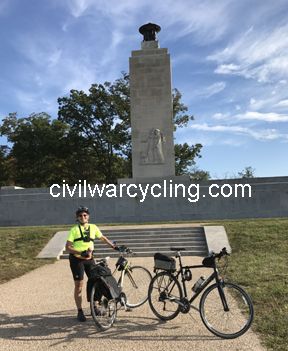
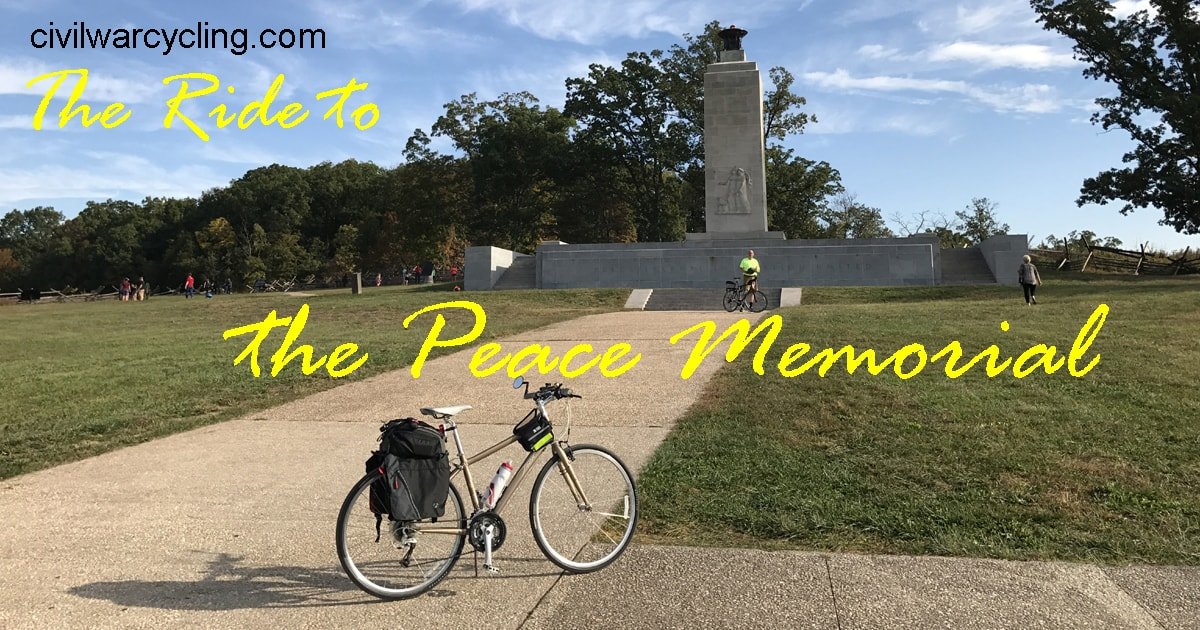
    On a bicycle, you can feel the battlefield advantage of making it to high ground. I had that experience on a bike ride to the Gettysburg Eternal Light Peace Memorial. In the spirit of sharing what it is like to pedal up to Oak Hill, I posted my GoPro video of the ride on my Civil War Cycling Facebook page. And in this blog post, I provide more geographical and historical context — plus a window to that bicycling video.

    Where is the Eternal Light Peace Memorial?

    The Eternal Light Peace Memorial is on Oak Hill, north of the town of Gettysburg, Pennsylvania. It was from here that Confederate artillery and infantry attacked the 1st Corps, Army of the Potomac, on July 1, 1863.

    President Franklin D. Roosevelt spoke at the memorial’s dedication on the 75th Anniversary of the Battle of Gettysburg in July, 1938. To symbolize peace between between warring sections of the country, Maine granite at the monument base joins the Alabama limestone column. An estimated one-quarter of one million people assembled on Oak Hill to celebrate the dedication of the Eternal Light Peace Memorial.

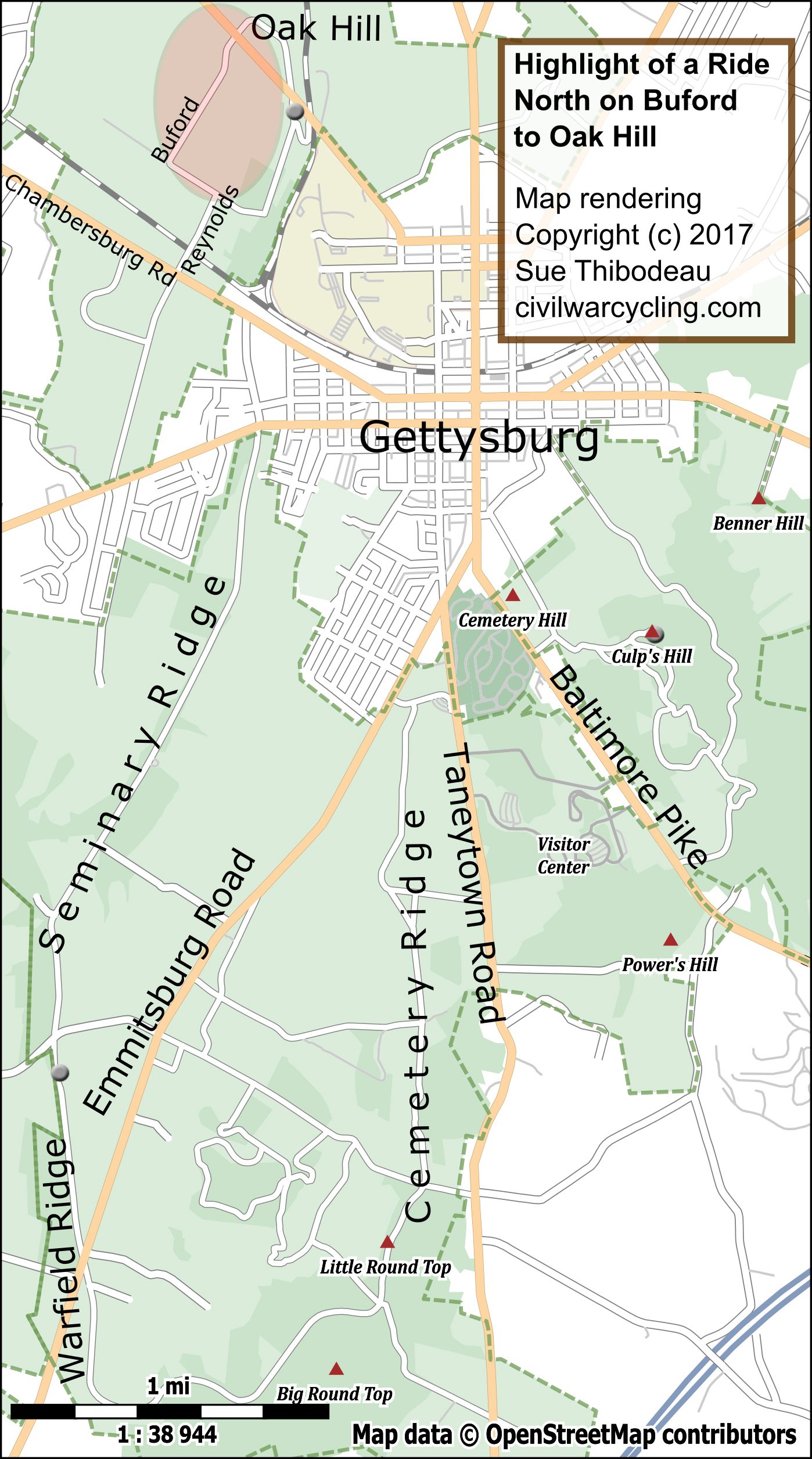
    North on Buford Avenue to Oak Hill

    bike ride to the Gettysburg Eternal Light Peace Memorial

    Our video begins at the intersection of North Reynolds Avenue and Buford Avenue, where we turn left (west) and enjoy a subtle downward glide to about 560-feet Mean Sea Level. During this first leg of our short tour, we are riding down the west edge of Seminary Ridge.

    As we veer sharply right — still on Buford Avenue — and ride north, we begin a gradual but noticeable incline. Buford Avenue runs north toward Oak Hill and marks a battle line along which Confederate infantry attacked Union cavalry from the west.

    Buford Avenue is named after Maj. Gen. John Buford, the 1st Corps cavalry commander who held back Confederate Maj. Gen. Henry Heth’s infantry on the morning of July 1, 1863, until Union infantry under Maj. Gen. John F. Reynolds could arrive in Gettysburg.

    The video of my  bike ride to the Gettysburg Eternal Light Peace Memorial shows a bicyclist passing five monuments on the east (right) side of the road. For your convenience, the following links to Steve Hawks’ Gettysburg Stone Sentinels describe those monuments:

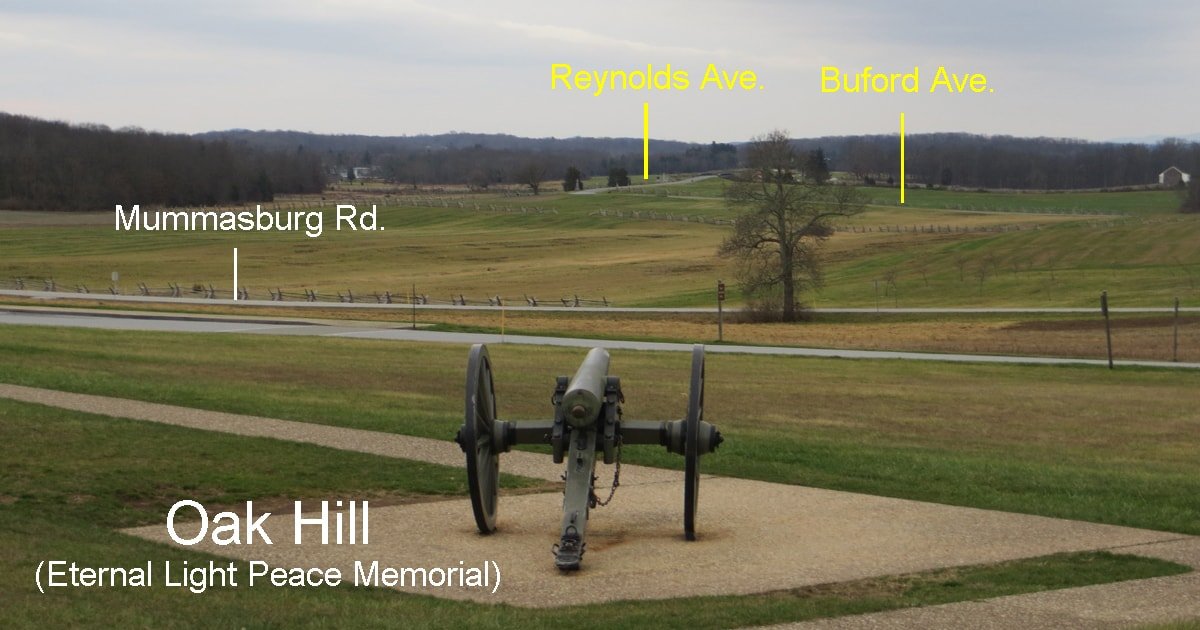
    We follow Buford Avenue north all the way to the Eternal Light Peace Memorial at the top of the hill. According to the U. S. Geological Survey, Oak Hill stands at 616-feet Mean Sea Level, which means that we will have climbed about 56-feet. The next photograph was taken while standing just west of the Peace Memorial (January 1, 2016). Looking down from Oak Hill, you can see the roads a bicyclist would follow — from Reynolds Avenue to Buford Avenue and finally crossing Mummasburg Road to arrive at Oak Hill.

    bike ride to the Gettysburg Eternal Light Peace Memorial
    View Looking South from Oak Hill

    Bike Ride to the Gettysburg Eternal Light Peace Memorial – A Video

    March 2025 Update: For performance reasons, our video has been removed from this web site. I apologize for any inconvenience.

  • Flying Down Culp’s Hill on a Bicycle – A Video

    Flying Down Culp’s Hill on a Bicycle – A Video

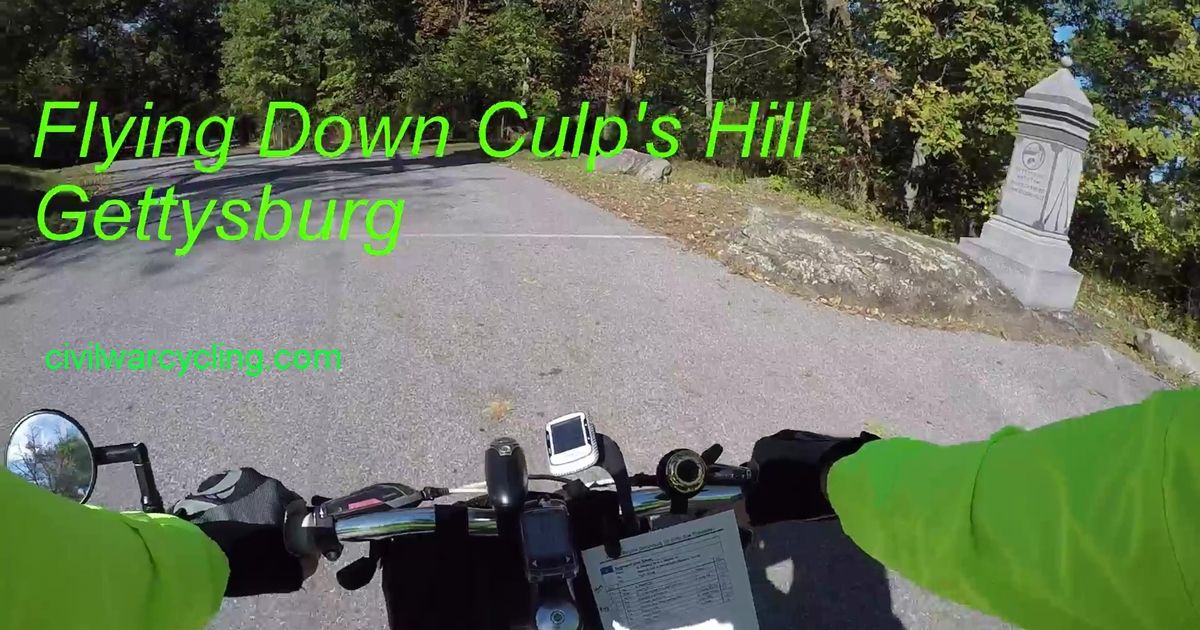
    The thrill of flying down Culp’s Hill on a bicycle is an unmatched experience for Gettysburg tourists. To give you a feel for this exhilarating and all-too-short ride, I posted my GoPro video of the ride on my Civil War Cycling Facebook page. And in this blog post, I provide more geographical and historical context — plus a window to that bicycling video.

    Where is Culp’s Hill?

    Culp’s Hill is southeast of the town of Gettysburg. Young Gettysburg native Wesley Culp — a member of the family for whom the hill was named — was living in Virginia when the Civil War started. He joined the Confederate army as a private and fought and died at the Battle of Gettysburg. We do not know where he died or where he is buried.

    Culp’s Hill was the right anchor of the Union line during the battle. According to the U.S. Geological Survey, the hill is at 629 feet Mean Sea Level. The lowest nearby location is Spangler’s Spring, which is at 469 feet Mean Sea Level.

    The paved park road from Spangler’s Spring to the summit of Culp’s Hill is a steep 160-foot, 3/4-mile climb up Slocum Avenue, a road that was named after Major General Henry W. Slocum (1826-94), commander of the Union right wing at the Battle of Gettysburg (July 1-3, 1863). The ride down Culp’s Hill is also part of Slocum Avenue.

    Flying Down Culp’s Hill on a Bicycle – A Video

    Our video begins at the summit of Culp’s Hill — at an observation tower built in 1895 — and follows Slocum Avenue down (southwest) to Stevens’ Knoll. We end at the road’s intersection with Wainwright Avenue, near a monument to the 33rd MA Infantry.

    March 2025 Update: For performance reasons, our video has been removed from this web site. I apologize for any inconvenience. 

    The ride down Culp’s Hill is a fast 0.2 mile glide into Stevens’ Knoll, where — not visible in the video — stand several restored Civil War Era cannon and a couple monuments, most notably the equestrian monument of Major General Henry W. Slocum.

    We bend north another 0.1 miles to reach the 33rd MA Infantry monument, on our right. East Cemetery Hill is straight-ahead. From the fields to our right, Confederates attacked East Cemetery Hill and Stevens’ Knoll.

    What Happened at Culp’s Hill?

    flying down culp's hill on a bicycle
    Culp’s Hill marks the Union right.

    On Culp’s Hill, Union troops dug earthen trenches that prevented Confederates from gaining the high ground, and thus protected the Union line that wrapped west around Cemetery Hill and then south along Cemetery Ridge to Little Round Top.

    On July 2, 1863, at about 4:00 P.M., Confederate artillery on Benner Hill bombarded Union positions on Culp’s Hill and Stevens’ Knoll. From about 8:00 – 10:00 P.M., Confederate infantry attacked Culp’s Hill from the east (along modern-day East Confederate Avenue). The Union line held.

    On July 3, 1863, early in the morning, Union infantry on Culp’s Hill launched a surprise attack on the Confederates. By 11:00 A.M., the battlefield action on Culp’s Hill ended with the Confederates falling back.

    It is interesting to note that the two oldest Union and Confederate generals at the Battle of Gettysburg fought each other on Culp’s Hill. Union general George S. Greene was 62 years old, and Confederate general William Smith was 65 years old.

  • 6 Steps to Create Your Own Gettysburg Scavenger Hunt

    6 Steps to Create Your Own Gettysburg Scavenger Hunt

    Have you ever thought about creating your own Gettysburg scavenger hunt? For bicycling? With over 1,300 monuments and markers in Gettysburg National Military Park, the battlefield is a rich wonderland of opportunities. Try these step-by-step instructions to plan your next history tour. And I’m going to make it easy for you. Read on to see how.

    What is a Battlefield Scavenger Hunt?

    Civil War Cycling is about touring U.S. national military parks by pedaling along park roadways. With that in mind, when we speak about “scavenger hunts,” we are talking about riding our bicycles on park roads in search of specific historical artifacts or structures.
    scav·eng·er hunt /’skavənjər hənt/
    noun: scavenger hunt; plural noun: scavenger hunts
    a game, typically played in an extensive outdoor area, in which participants have to collect a number of miscellaneous objects. Source: Google

    Bicycling historians “scavenge” the outdoors to find items on a “scavenger hunt” list. For me, the hunt is complete when I have snapped photographs of everything on my list.

    Examples

    1. Seven USA state monuments at Gettysburg National Military Park (GNMP)
    2. Eleven CSA state monuments at GNMP
    3. Eight equestrian monuments at GNMP
    4. Eighteen (plus two) bronze statues of individuals at GNMP or nearby cemeteries

    Why Plan a Gettysburg Scavenger Hunt?

    Gettysburg scavenger hunt

    Gettysburg National Military Park has 1,300+ monuments and about 400 refurbished cannon spread over 6,000+ acres and about thirty-one miles of park roads. Clearly, that is way too much to see in a single day’s ride. I have no idea how long it would take to visit every monument or marker, and I have logged dozens of full-day rides.

    Even so, these massive numbers do not make a Gettysburg scavenger hunt necessary. You could, for example, enjoy freely exploring the park and stopping to read historic waysides and monument inscriptions in a random, possibly whimsical, manner. Admittedly, when I take three-day bicycling trips to Gettysburg, my last day is always dedicated to that sort of impulsive, free-form ride.

    Why plan a battlefield scavenger hunt?

    First, because it is an effective way to learn history.

    If you begin your ride with a plan to visit a particular set of monuments that share a common theme, your learning experience is strengthened. In other words, scavenger hunts offer a coherent and thematic — as opposed to a random, disjointed — learning opportunity.

    Second, because it gives a solid sense of accomplishment.

    If you are bicycling a U.S. national military park in order to learn more about American history, a ride that is focused on a particular historical theme or goal provides a greater sense of accomplishment than if the ride had no defined historical objective.

    For example, in my first attempt to identify, map, find, and photograph all corps headquarter monuments at Gettysburg, I probably found only about half of them. There are many reasons for a less-than-perfect “score” on my Gettysburg scavenger hunt — including the monuments’ small sizes, their odd locations, and even bad weather and a drained camera battery. But that’s not the point; instead, the point is that I felt a strong sense of accomplishment when I was able to complete that hunt on another ride.

    Third, because it is fun.

    Scavenger hunts provide bicyclists an opportunity to combine hobbies like bicycling, history, cartography, and photography into one outdoor learning adventure.

    What Makes for a Great Battlefield Scavenger Hunt?

    The key to planning a Gettysburg bicycle route that visits a meaningful set of sites is to scale-down your expectations of what can be accomplished on a single day’s ride.

    In a nutshell, there are four criteria for a great battlefield scavenger hunt:

    1. The list contains historically interesting physical items that you can photograph.
    2. It is logistically possible to find all items on the list in one ride or set of smaller rides.
    3. You or someone else has researched the (paper) location of each item on the map.
    4. During your ride, you have a way to “check off” each item that you find.

    6 Steps to Create a Gettysburg Scavenger Hunt

    I said that I’d make this easy for you, and I will! Please follow these step-by-step instructions:

    Step 1 – Visit Web Link

    Visit Civil War Cycling’s “Gettysburg Scavenger Hunts – Explore Like a Kid” page. Skim the evergreen, multi-page table of scavenger hunts available for your use. Pick one that interests you.

    Step 2 – Click on “Hunt”

    Next, click on one of the “Hunt” links on the page from Step 1. If you have never bicycled Gettysburg, I recommend that you select one of the following hunts:

    1. USA State Monuments
    2. CSA State Monuments
    3. Equestrian Monuments

    Then read the short introduction at the top of the article.

    Step 3 – Read and Think

    For a single hunt, study the following on the “Hunt” page that you selected in Step 2:

    1. Table description of each monument
    2. Map pin for each monument
    3. Photo of each monument

    And then most importantly, do the mental work of jumping from table to map to photograph — in whatever order makes sense to you — as you memorize the attributes of each monument:

    1. Name (from the table)
    2. Location (map pin)
    3. Appearance (photo)

    Step 4 – Make a Simple Map

    Download a PDF map of Gettysburg National Military Park. A paper version is also available in the kiosks at the Gettysburg Museum and Visitor Center.

    Refer to Civil War Cycling’s pins on Google Maps, and then mark their location on your paper map. Let it be messy. After all, your “trophy” for the hunt is a set of photos.

    Step 5 – Design a Bicycle Route

    This next step probably requires the most thought, but most bicycling tourists enjoy it:

    Design a circular route that visits each location that you marked on your map from Step 4. If you’d like to skip ahead, it is very likely that one of Civil War Cycling’s pre-made bicycle routes will work for you.

    In future posts, I will offer detailed guidance with the finer points of bicycling Gettysburg National Military Park safely and efficiently. However, if you will be riding before those posts are available, please consider reading these articles first:

    Step 6 – Ride

    Finally, please enjoy your ride! Hunt with your camera, and check-off what you find (in case you need to repeat your Gettysburg scavenger hunt on another ride).

  • Gettysburg Statues of Individual Heroes – Simple Drills for Fun

    Gettysburg Statues of Individual Heroes – Simple Drills for Fun

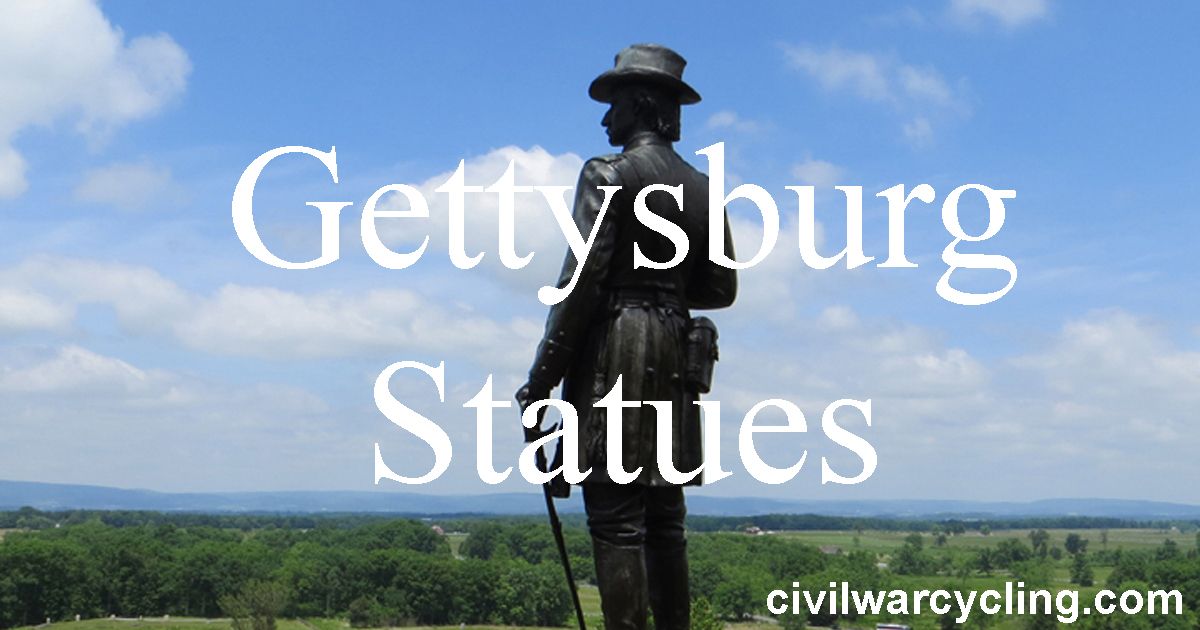
    What do you know about the twenty bronze statues at Gettysburg? Today, we feature Gettysburg statues that honor individual heroes, military and civilian. Test your knowledge by playing with Civil War Cycling’s interactive quizzes.

    Gettysburg Statues of Individual Heroes

    Even if you know very little about the Battle of Gettysburg, today’s quizzes are an easy way to learn a lot. We start with two short, anonymous quizzes and an invitation to take a deeper dive at the end.

    Beginner Quiz – Know Your Heroes

    Gettysburg statues

    Here is an accordion-style quiz. Please consider it an opportunity to PLAY.

    Instructions: Read the question, think whether you might know the answer, and regardless, click on the question to uncover the answer. All answers are drawn from the following name bank.

    NAME BANK:
    Francis C. Barlow, John Buford,  John L. Burns, William Corby, Samuel W. Crawford, Abner Doubleday, John W. Geary, John Gibbon, George S. Greene, Alexander Hays, Andrew A. Humphreys, John F. Reynolds, John C. Robinson, Elizabeth Thorn, Mary Virginia “Jennie” Wade, James S. Wadsworth, Gouverneur K. Warren, Alexander S. Webb, Albert H. Woolson, William W. Wells.

    Answers: The answers are below the questions.

    Intermediate Quiz – Whose Monument Is This?

    Gettysburg statues

    This isn’t a traditional quiz. It is designed to help you to learn, not to grade your performance. That’s why there is nothing to do but read, think, and then move your mouse (or finger on a mobile device) to hover over the photograph that answers the question.

    Instructions: For each of the five questions (below), identify the photograph that answers the question. The photo captions make it clear whether you are correct.

    Questions:

    1 – Which monument (above) honors Rev. William Corby (1833–97), the chaplain of the 88th New York Infantry (part of the Irish Brigade) and also the future President of the University of Notre Dame?

    2 – Which monument honors Meade’s Chief Engineer, Gouverneur K. Warren (1830–82), the man who was credited with first recognizing that Little Round Top was undefended on July 2, 1863?

    3 – Which monument honors Mary Virginia “Jennie” Wade (1843–63), the only known civilian killed during the Battle of Gettysburg.

    4 – Which monument honors the highest ranking officer killed at Gettysburg and commander of the 1st Corps, Army of the Potomac, John F. Reynolds (1820–63).

    5 – Which monument honors cavalry division commander, John Buford (1826–63), a Kentucky native?

    Answers: The answers are in the photo captions, below. 

    Advanced Exploration – Curious to Know More?

    Gettysburg statues

    Instructions: Follow the next link to an article that contains photographs, a short history, another interactive quiz, and a scavenger hunt with a map.

    Wrap-Up – Gettysburg Statues of Individual Heroes

    I hope that you had fun drilling the basics. Civil War Cycling’s tools are just that — tools to help you learn. And to learn “just enough” to motivate you to bicycle Gettysburg National Military Park.

  • Amos Humiston in Soldiers National Cemetery

    Amos Humiston in Soldiers National Cemetery

    Not many people know how to find graves in Soldiers National Cemetery. Even if you have a plot number, good luck without a map — and good luck finding a helpful map! Oh, wait. You found this Civil War Cycling blog post, so you are all set. This post summarizes why it’s hard even for experienced genealogists to find Union graves like that of Amos Humiston in Soldiers National Cemetery. And better, it points you to step-by-step instructions for finding a grave in Soldiers National Cemetery, given a plot number like “NY Plot B-14.”

    First, a Story

    On July 1, 1863, the Union 1st and 11th Corps battle lines collapsed. Union soldiers retreated through the town of Gettysburg to high ground south of town, known as Cemetery Hill, where Gen. Oliver O. Howard had positioned artillery earlier in the day.

    Amos Humiston in Soldiers National Cemetery
    Children of Sgt. Amos Humiston (LOC)

    Among the men who provided covering fire for the retreat was Sgt. Amos Humiston of the 154th New York Infantry. Humiston was part of Col. Charles Coster’s  Brigade (in the 2nd Division, 11th Corps). He died in the streets of Gettysburg, near the modern-day fire department at a railroad crossing, and was found by a local girl who removed from his hands an ambrotype portrait of three young children. After a national search to identify the dead solider, Humiston’s wife, Philinda, learned that she was widowed and that her children — Frank, Frederick, and Alice — were now fatherless.

    Amos Humiston in Soldiers National Cemetery

    Amos Humiston in Soldiers National Cemetery

    Soldiers’ National Cemetery is the burial place of over 3,600 Union soldiers who died from wounds sustained at the Battle of Gettysburg. I had read that Sgt. Amos Humiston was buried in NY Plot B-14. One would think that that is more than enough information to find his grave in the cemetery. After all, there is a cemetery map at the entrance of the cemetery that shows the locations of each state’s graves.

    It was not hard to find the New York section. But it was very time consuming to find B-14. Honestly, I cannot really say that on my first visit to Humiston’s grave that I actually found B-14. I walked up and down almost every row (sometimes doubling-back) until I found a stone with this unusually clear marking: “SERGT A. HUMISTON. CO. C. REGT. 154.” Most stones are more cryptic and may not even have a name.

    The challenge for a cemetery visitor is that there are no signs or pamphlets that identify section letters (“B”) or gravestone numbers (“14”). Even more surprising, when I scoured the web and many bookstores for a schematic map of Soldiers’ National Cemetery, I found nothing that would help me to identify the physical location of “NY Plot B-14.” Fortunately, though, I found one excellent resource that helped me to figure out what I want to know:

    James M. Cole and Rev. Roy E. Frampton, Lincoln and the Human Interest Stories of the Gettysburg National Cemetery (Hanover, PA: The Sheridan Press, 1995).

    2024 Update: On a recent trip to Gettysburg, I noticed new wayside exhibits at both entrances to the national cemetery. They new maps are very helpful!

    Find Graves in Soldiers National Cemetery

    If you want clear, step-by-step instructions for finding a gravestone — given a plot number  — at Soldiers’ National Cemetery, you are in luck! I wrote an article on this very topic. Using “NY Plot B-14” as an example, the article explains how to locate the state section, the row, and the grave marker. We will find the grave of Amos Humiston in Soldiers National Cemetery.

    Please see “How to Find Graves in Soldiers National Cemetery,” or click on the following map.


    find graves in Soldiers National Cemetery
    A Schematic Map of Soldiers’ National Cemetery
  • How to Find Gettysburg Witness Trees on a Bicycle

    How to Find Gettysburg Witness Trees on a Bicycle

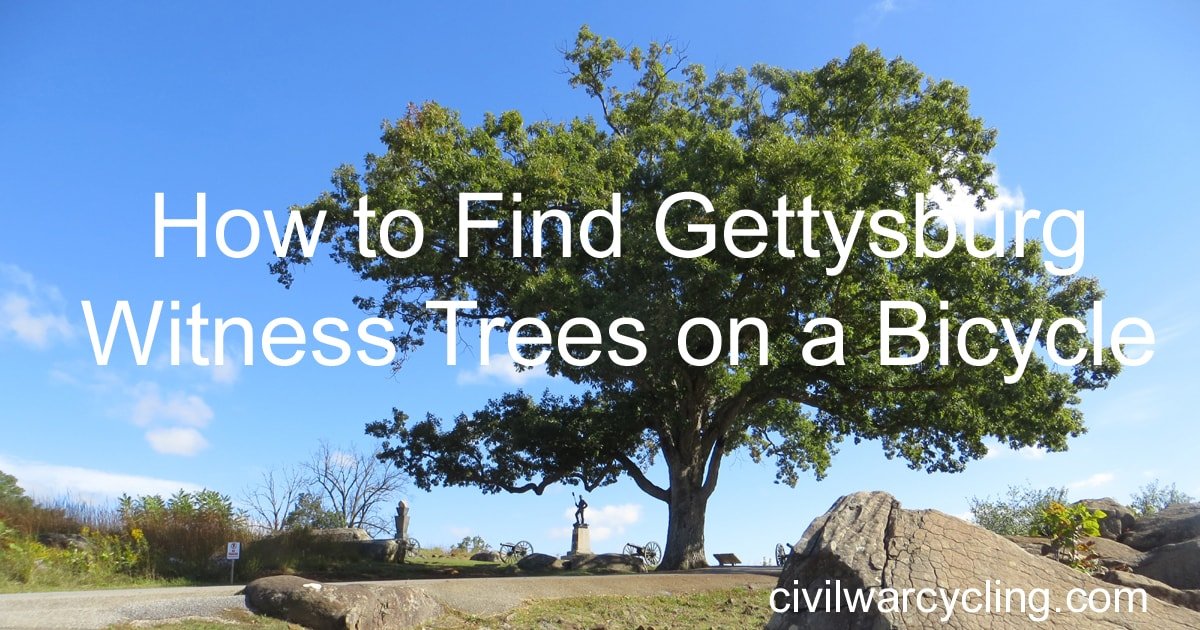
    A “witness tree” is a tree that was alive in 1863 to “witness” the Battle of Gettysburg. Today’s post is about how to find Gettysburg witness trees on a bicycle. It’s an introduction to the topic and a pointer to a detailed guide. What does a bicyclist need in order to find these trees? Simply this: a map, some photos, and a little route planning. You’ve come to the right spot! This blog post reminds our readers about a Civil War Cycling article from years past, “What is a Gettysburg Witness Tree? And Where to Look.” 

    how to find Gettysburg witness trees on a bicycle
    Devil’s Den Oak Tree

    The article provides detailed instructions on how to find Gettysburg witness trees on a bicycle, including GPS coordinates and labeled photos  Some witness trees are named after soldiers who were killed or wounded at a particular location, so the article weaves historical tidbits into the trees’ descriptions.

    2025 Update: For more comprehensive instructions for finding Gettysburg witness trees by car or on foot, I recommend the following resources: gettysburgsentinels.com/blog/ and gettysburgwitnesstrees.com/main-map/.

    How to Find Gettysburg Witness Trees on a Bicycle

    how to find Gettysburg witness trees on a bicycle
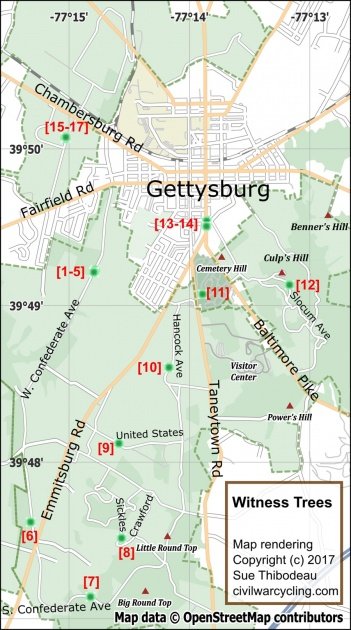
    Map of Gettysburg Witness Trees

    It’s fun to turn a bicycle tour into a scavenger hunt. My camera is the tool for “shooting” my find. My “trophy” is a photo and GPS coordinates that I add to my collection. And the perfect circular bicycle route that passes by each tree is the solution to a puzzle. All in all, it’s fun playtime outdoors.

    Gettysburg witness trees are particularly challenging to find, and of course, that’s part of the fun. As best I remember, there are no park signs that help with tree identification. And although the National Park Service has tagged many trees, almost as many green (oxidized) metal identification tags have disappeared. What tags exist can be difficult to spot on overcast days, or when trees are casting a lot of shade.

    Accessibility to bicyclists is another issue. For example, the Honey Locust Witness Tree [11] is inaccessible to bicyclists, since it stands in Soldiers’ National Cemetery, where bicycles are not allowed.

    To find witness trees you need three things: a map, labeled photographs, and a bicycle route. Please read on …

    1 – Look at a map.

    The map provided in this post identifies seventeen witness trees. The numbering scheme is mine (because NPS tags are missing on most of the trees). I numbered the trees according to the order that I would visit them on a bicycle route. The numbers also match-up to the labeled photos provided in the article, “What is a Gettysburg Witness Tree? And Where to Look.”

    2 – Study labeled photos.

    how to find Gettysburg witness trees on a bicycle
    Honey Locust (deceased) in National Cemetery

    There are twenty six labeled photos in Civil War Cycling’s detailed guide on how to find Gettysburg witness trees on a bicycle. You’re going to want to bring these photos with you on your ride (or access them through a cell phone connection to the web).

    Unless you are a master at locating objects with GPS coordinates (which I also provide), labeled photos are the best tool for finding Gettysburg witness trees. Although these photos are an indispensable help to finding the trees, you will still feel like you are working on a puzzle. That’s because trees look different through the seasons, and weather and age will also change their appearance. You may pedal past a tree and need to circle back — which, of course, is part of the fun of exploring the park on a bicycle.

    Sadly, there is no guarantee that a tree will live forever, and that’s an obvious complication for bicyclists who are “hunting” for witness trees. For example, the Honey Locust [11] that stands near the iron fence that separates Soldiers’ National Cemetery from Evergreen Cemetery was struck by lightening in recent years and was severely damaged. As of this writing, it is alive. You can see the damage in the photo provided in this post.

    If you have a map and some photos that correspond to locations on the map, you have the tools that you need. The article, “What is a Gettysburg Witness Tree? And Where to Look,” helps by describing each tree’s location, listing GPS coordinates, providing labeled photos, and summarizing distinguishing features, like the presence of “lightning cable scars” or the type of tree (although most are oak trees).

    3 – Plan your route.

    If your only goal for bicycling is to find witness trees, you will need a plan. That’s because it’s highly unlikely that you can accidentally find these trees. In fact, I did not accidentally find them either! In 2008, the Gettysburg Daily website posted a series of articles on Gettysburg Witness Trees, and those articles pointed me in the right direction.

    On the other hand, if your primary goal is to hunt for monuments or to simply enjoy the Gettysburg landscape and read historic waysides, then it’s probably enough to identify a few trees and try to incorporate finding them along your existing route.

    Enjoy Your Ride

    One reason why I love bicycling Gettysburg so much is that I am free to ride however I want. I get to decide what I want to learn, and how, and when. I am free to enjoy the entire experience. And for me, planning and executing my own “scavenger hunt” is a fun addition to an invigorating ride.

  • Master Gettysburg Day 3 – A Beginner Warm-Up Quiz

    Master Gettysburg Day 3 – A Beginner Warm-Up Quiz

    You can master Gettysburg Day 3 by playing with this interactive quiz. It is short and sweet. Re-take it until you master the basics. No one is watching.

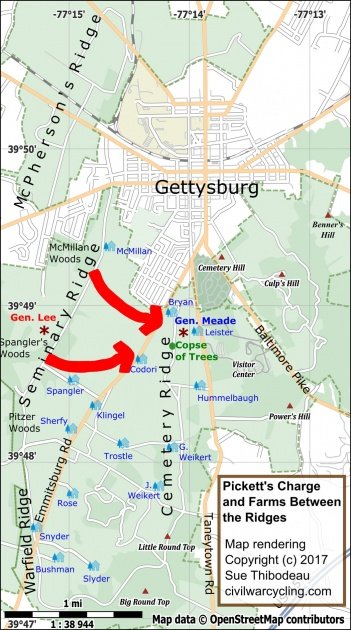
    For history students looking for an extremely concise summary of the Battle of Gettysburg for July 3, 1863, I refer you to Civil War Cycling’s Summary – Battle of Gettysburg Day 3. Don’t miss this article, as it includes high-level maps, photos, and nutshell summaries. Also, if you need help with military terminology, please see our Civil War Glossary.

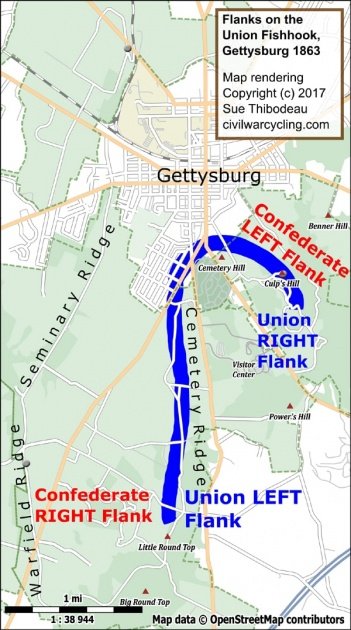
    Let’s Start with a Map

    master Gettysburg Day 3

    Master Gettysburg Day 3 – A Beginner Warm-Up Quiz

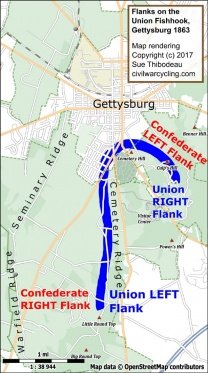
    Click or tap the question to see the answer. Tip: If you forget what “left flank” and “right flank” mean, see this Civil War Cycling blog post: “Buzzwords, De-Buzzed – 5 Keys to Unlocking Civil War Terminology.” It has a picture of the Union fishhook formation that applies to Gettysburg Day 3.

    Master Gettysburg Day 3 – Study Notes

    Click here
    Click here

    Honestly, when I first started studying the Battle of Gettysburg, I was overwhelmed with details that made it really hard to see the forest for the trees. That’s why I posted my study notes on the Civil War Cycling website.

    Summary – Battle of Gettysburg Day 3 is a study guide for July 3, 1863 — complete with photos, maps, text, and lists. It follows this outline:

    • Study Tips – A list of things that trip-up beginners.
    • Who’s Who? – Put a face to a name by viewing these portrait photos.
    • Nutshell Summary – A short, tight chronology with a map.
    • Detailed Summary – July 3, 1863, described in conceptual “phases” with maps and photos.
      1. Renewed Fighting on Culp’s Hill
        • Cheat-Sheet (with battle rosters)
        • Details
      2. Pickett’s Charge to Cemetery Ridge
        • Cheat-Sheet (with battle rosters)
        • Flank Support for Pickett’s Charge
        • The Plan to Charge the Center
        • Artillery Bombardment
        • Pickett’s Charge
        • High Water Mark Debates
    • Aftermath – Casualty counts

    Union Generals – Photo Sampling for Day 3

    Which of these Union generals do you recognize? To read their names, use your mouse to hover over each image (or tap lightly on your mobile device).

    Confederate Generals – Photo Sampling for Day 3

    Which of these Confederate generals do you recognize? To read their names, use your mouse to hover over each image (or tap lightly on your mobile device).

    Try Our “Who’s Who” Flashcards!

    An “Order of Battle” is a battle roster. Civil War Cycling offers Orders of Battle in the form of flashcards to the brigade-level. They are interactive, anonymous, and free. Please start here:

  • Master Gettysburg Day 2 – A Beginner Warm-Up Quiz

    Master Gettysburg Day 2 – A Beginner Warm-Up Quiz

    You can master Gettysburg Day 2 by playing with this interactive quiz. It is short and sweet. Re-take it until you master the basics. No one is watching.

    For history students looking for an extremely concise summary of the Battle of Gettysburg for July 2, 1863, I refer you to Civil War Cycling’s Summary – Battle of Gettysburg Day 2. Don’t miss this article, as it includes high-level maps, photos, and nutshell summaries. Also, if you need help with military terminology, please see our Civil War Glossary.

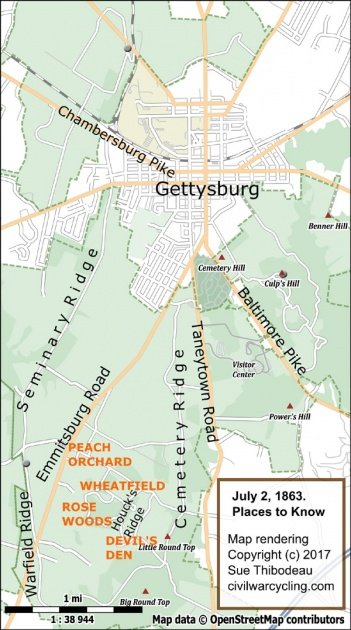
    Let’s Start with a Couple Maps

    master Gettysburg Day 2
    master Gettysburg Day 2

    Master Gettysburg Day 2 – A Beginner Warm-Up Quiz

    Click or tap the question to see the answer.

    Master Gettysburg Day 2 – Study Notes

    Click here
    Click here

    Honestly, when I first started studying the Battle of Gettysburg, I was overwhelmed with details that made it really hard to see the forest for the trees. That’s why I posted my study notes on the Civil War Cycling website.

    Summary – Battle of Gettysburg Day 2 is a study guide for July 2, 1863 — complete with photos, maps, text, and lists. It follows this outline:

    • Study Tips – A list of things that trip-up beginners.
    • Who’s Who? – Put a face to a name by viewing these portrait photos.
    • Nutshell Summary – A short, tight chronology with a map.
    • Detailed Summary – July 2, 1863, described in conceptual “phases” with maps and photos.
      1. Attack on the Union Left Flank
        • Cheat Sheet (with battle rosters)
        • Devil’s Den
        • Little Round Top
        • The Wheatfield and Rose Woods
        • The Peach Orchard
        • The Union Center at Cemetery Ridge
        • Little Round Top (Through the Valley of Death)
      2. Attack on the Union Right Flank
        • Cheat Sheet (with battle rosters)
        • Cemetery Hill
        • Culp’s Hill
    • Aftermath – Casualty counts

    Union Generals – Photo Sampling for Day 2

    Which of these Union generals do you recognize? To read their names, use your mouse to hover over each image (or tap lightly on your mobile device).

    Confederate Generals – Photo Sampling for Day 2

    Which of these Confederate generals do you recognize? To read their names, use your mouse to hover over each image (or tap lightly on your mobile device).

    Try Our “Who’s Who” Flashcards!

    An “Order of Battle” is a battle roster. Civil War Cycling offers Orders of Battle in the form of flashcards to the brigade-level. They are interactive, anonymous, and free. Please start here:

  • Master Gettysburg Day 1 – A Beginner Warm-Up Quiz

    Master Gettysburg Day 1 – A Beginner Warm-Up Quiz

    You can master Gettysburg Day 1 by playing with this interactive quiz. It is short and sweet. Re-take it until you master the basics. No one is watching.

    For history students looking for an extremely concise summary of the Battle of Gettysburg for July 1, 1863, I refer you to Civil War Cycling’s Summary – Battle of Gettysburg Day 1. Don’t miss this article, as it includes high-level maps, photos, and nutshell summaries. Also, if you need help with military terminology, please see our Civil War Glossary.

    Let’s Start with a Map

    master Gettysburg Day 1

    Master Gettysburg Day 1 – A Beginner Warm-Up Quiz

    Click or tap the question to see the answer.

    Master Gettysburg Day 1 – Study Notes

    Click here
    Click here

    Honestly, when I first started studying the Battle of Gettysburg, I was overwhelmed with details that made it really hard to see the forest for the trees. That’s why I posted my study notes on the Civil War Cycling website.

    Summary – Battle of Gettysburg Day 1 is a study guide for July 1, 1863 — complete with photos, maps, text, and lists. It follows this outline:

    • Study Tips – A list of things that trip-up beginners.
    • Who’s Who? – Put a face to a name by viewing these portrait photos.
    • Nutshell Summary – A short, tight chronology with a map.
    • Detailed Summary – July 1, 1863, described in conceptual “phases” with maps and photos.
      1. Cheat Sheet (with battle rosters)
      2. Battle at Herr and McPherson’s Ridges
      3. Attack From Oak Hill
      4. Flank Attack at Barlow’s Knoll
      5. Union Retreat Through Town
    • Aftermath – Casualty counts

    Union Generals – Photo Sampling for Day 1

    Which of these Union generals do you recognize? To read their names, use your mouse to hover over each image (or tap lightly on your mobile device). Note that Maj. Gen. George G. Meade, commander of the Army of the Potomac, is not shown, because he arrived very late in the day. (The bulk of his army was en-route to Gettysburg on July 1, 1863, and arrived in waves.)

    Confederate Generals – Photo Sampling for Day 1

    Which of these Confederate generals do you recognize? To read their names, use your mouse to hover over each image (or tap lightly on your mobile device).

    Try Our “Who’s Who” Flashcards!

    An “Order of Battle” is a battle roster. Civil War Cycling offers Orders of Battle in the form of flashcards to the brigade-level. They are interactive, anonymous, and free. Please start here: