NEWS: While researching my 2021 guidebook, Bicycling Chickamauga Battlefield: The Cyclist’s Civil War Travel Guide(paid link), I bought many books on the Battle of Chickamauga (September, 1863). Each book contributed something unique to my studies. All of them helped me to design a historical touring guide for cyclists. Today, I added annotations to my bibliography on this landmark battle, and I posted them here: “Chickamauga Reading Recommendations.”
I hope that the descriptions help you to find your next great book. Disclosure: As an Amazon Associate, I earn from qualifying purchases when you click book links (at no cost to you).
If I could pick only one book for a first study of the Battle of Chickamauga, it would be this one:
Only 134 pages but masterfully written, Woodworth’s book includes fourteen black-and-white military maps that align well with the text. The book presents a clear, flowing military narrative that includes biographical sketches and portrait photos that enliven the battlefield story. The book includes orders of battle (but inexplicably omits the provisional division command of Brig. Gen. Bushrod R. Johnson). There is a section on “Further Reading” that is helpful for its inclusion of memoirs and biographies. The book’s index focuses on people and places. There are no notes.
For a comprehensive history of the battle that includes detailed maps, my favorite book is:
This is a must-have companion for any student of the Battle of Chickamauga. The maps span June 24 to September 23, 1863. Powell describes military actions on left-facing pages. Right-facing pages are Friedrichs’ (color) maps. The book includes two appendixes with orders of battle, one for Tullahoma and one for Chickamauga.
For short but interesting military summaries that do not neglect the “human interest” elements of the battle, it’s a toss-up:
I recommend both of the following authors (for different reasons), both of whom give battlefield tours. To learn more, please visit “Chickamauga Reading Recommendations.”
White, William Lee. Bushwhacking on a Grand Scale: The Battle of Chickamauga, September 18–20, 1863. El Dorado Hills, CA: Savas Beatie, 2013.
Carter, Robert L. The Fight for Snodgrass Hill and the Rock of Chickamauga: A History and Walking Tour. With cartography by James A. Boyd. Carrollton, GA: Melica Books, 2012.
———. Longstreet’s Breakthrough at Chickamauga: Accidental Victory; A History and Walking Tour. With cartography by James A. Boyd. Carrollton, GA: Melica Books, 2014.
Happy reading adventures!
I hope you can take the time to peruse all the books in Civil War Cycling’s annotated bibliography for the Battle of Chickamauga and the more general topics of the Chickamauga battlefield and tourism.
Today, I took an exciting next step: I added bibliographic annotations to Civil War Cycling’s collection of Antietam titles. You can find these detailed book descriptions on the web page titled “Antietam and C&O Canal Reading Recommendations.” Even though the bibliography includes dozens of titles, each book offers a unique perspective. Whether you’re interested in battle tactics, personal stories, or historical interpretation, there’s something here for every kind of reader.
To help you find your next great read, I’ve included personal notes on what makes each book special. (Disclosure: As an Amazon Associate, I earn from qualifying purchases when you click book links—at no cost to you.)
Top Pick—Battle Maneuvers
If I had to recommend one book for serious study of the Battle of Antietam, it would be:
This book is a visual gem. On each left-facing page, you’ll find a concise narrative of a particular phase of the battle. On the opposite page, color maps bring that narrative to life with exceptional clarity. It’s perfect for those who want to understand the battle’s flow in both words and visuals.
Top Pick—Battle Themes
That said, my interests go beyond military maneuvers and battlefield strategy. For a broader, thematic view of the conflict, I turn to this classic:
Sears’ book is widely regarded as a masterpiece of Civil War literature. It reads with the drama of a novel but rests on rigorous scholarship. It’s a go-to for readers who want a compelling yet authoritative account of the battle and its significance.
Top Pick—Battle Impact
And yet—even that isn’t the whole story. Antietam’s history stretches far beyond troop movements. It also includes the lives of the people who lived and farmed on that land.
For a deeper understanding of the battlefield as a lived landscape, I highly recommend:
This illustrated guide focuses on the farms and families affected by the battle. It’s an essential read for anyone curious about the human and agricultural history of Sharpsburg in 1862.
Happy reading!
I hope you’ll explore the full annotated bibliography, which also includes titles on Civil War Maryland and tourism. There’s much to discover—and perhaps even more to appreciate—when you see this history from multiple perspectives.
Armies of Deliverance by Elizabeth R. Varon provides a sweeping, comprehensive, and eminently readable introduction to the U.S. Civil War. Recently published by Oxford University Press in 2021, Varon’s bold yet unassuming 531-page scholarly tome is no endless catalog of facts and opinions. On the contrary, it is a solid analysis of the fluid and evolving rationales for the war from the perspectives of the people who lived through it.
Notably, Armies of Deliverance chronicles a new history of the Civil War without neglecting military strategy and tactics. (Varon’s exploration of the war’s meaning is very helpful to bicyclists who are in the planning stages of a bike tour. It gives us something substantive to think about between battlefield stops, where we would read about battlefield events.)
Unique among a vast number of Civil War books, Armies of Deliverance unfurls a fascinating political and cultural history. Moreover, its thematic approach will appeal to undergraduate college students and history buffs. And at least for this reader, the book offers a refreshingly clear thesis that the author develops logically using primary source material.
As the story unfolds, Varon regularly revisits the question of how two governments, acting as two sets of armies, expressed their changing and multi-faceted reasons for executing the war. Armies of Deliverance includes a helpful U.S. Civil War timeline, a short glossary, several black-and-white maps, portrait photographs, and period sketches. Like all scholarly publications, Varon also includes sections for a bibliography, endnotes, and index.
Because the book does not focus predominantly on military battlefield history, Varon’s book is a welcome complement to James M. McPherson’s perennial classic, Battle Cry of Freedom. In summary, Armies of Deliverance is my new favorite one-volume history of four catastrophically divisive years in American history.
The Civil War Cycling website has a short list of recommended books on the U.S. Civil War, here. Alternatively, a lengthy annotated bibliography specific to the Battle of Gettysburg is available at this link. For the Battle of Antietam, click here.
How does someone play at learning U.S. Civil War history? Engaging with interactive web tools is one great place to start. For example, if you want to develop a more detailed understanding of the Battle of Gettysburg, try Civil War Cycling’s “Master Gettysburg July 3 with Interactive Tools.” These tools will help you to gain a “who’s who” knowledge of the principal battlefield commanders on July 3, 1863.
Click here for Master Gettysburg July 3
This is the third of three sets of quizzes and links to photos and maps on the Battle of Gettysburg. After playing with the quizzes, please share your feedback on any Civil War Cycling web page, or post a private comment through the “Contact Us” link.
Master Gettysburg July 3 with Interactive Tools
When it’s too cold to bicycle (or when you are too far away from a national park), interactive quizzes make it easy to beef-up your knowledge of the Battle of Gettysburg. They are “exercise equipment” for your brain. You will not be asked any personal information or need to click through annoying ads. Honestly, it’s just good ol’ healthy fun!
I am convinced more than ever that we need to put the play back into our study of American history. Mostly, I play on my bike. But in cold weather, I play with interactive history tools that I made for myself, because I couldn’t find anything on the web. I needed something short, simple, repetitive, and quick. And I needed these tools to help me make connections between people, places, things, and events. “Master Gettysburg July 2 with Interactive Tools” is one answer to the student’s problem of needing to master enough facts to get to the big, meaningful themes of history.
Click here for Master Gettysburg July 2
“Master Gettysburg July 2 with Interactive Tools” is the second of three sets of quizzes and links to photos and maps on the Battle of Gettysburg. Today, it’s July 2, 1863. Please let me know how these quizzes work for you. I would love to read your comments or feedback on any Civil War Cycling website page, or privately through the “Contact Us” link.
Master Gettysburg July 2 with Interactive Tools
Although I have two Master’s degrees (none in history) and so-called “smartness,” my first time reading Edwin Coddington’s 866-page classic tome, The Gettysburg Campaign: A Study in Command, was painful, because I knew very little about the battle. I didn’t know enough about Gettysburg to understand the main story line! So, I put the book aside for a long time.
Years later, after changing my approach to studying, I can read the book and understand it. One day, I hope to be able to read the book andremember more than what I do right now.
For me, what made all the difference in the world was injecting more time for fun in my studies.
It started by riding my bicycle through battlefields and taking time to enjoy the landscape, read the signs, and study monument inscriptions. I am obsessed with bicycling Gettysburg National Military Park. What I learned on those tours helped me to remember enough of Gettysburg “who’s who” to understand Coddington’s massive but well-written book. And during the winter months, creating online interactive quizzes helped me to solidify many factual details that floated around like free radicals in my brain.
The educator in me knows that a certain amount of memorization is necessary to understand history. And the larger the gap between the reader’s vocabulary and the educational text, the harder the learning process.
The fix is to find fun ways to drill the “facts” into your memory for safe-keeping. Civil War Cycling publishes interactive, online quizzes that supplement articles, photo galleries, videos, and maps that help learners like me.
Do you love U.S. Civil War history but feel overwhelmed with all the names, places, and jargon? Been there, done that! Today’s Civil War Cycling blog post announces the availability of a set of anonymous (and free) interactive quizzes designed to help you memorize the principal commanders at the Battle of Gettysburg for fighting on July 1, 1863. Now’s the time to master Gettysburg July 1 with interactive tools.
Today, it’s bitterly cold across much of the United States. In fact, Gettysburg National Military Park — which is usually open all but a couple days of the year — had to close its roads for a short time due to the snow. So, as long as you’re inside (and hopefully, warm), why not hibernate with a good plan to study the Gettysburg Campaign?!
Master Gettysburg July 1 with Interactive Tools
Click here for Master Gettysburg July 1
I’m a former high school teacher and corporate manager. I’ve worked with lots of different people who learn in many different ways. In my experience, if an adult is motivated to master a subject, then memorization and drilling can be helpful — in small doses, in fun ways, and always easily associated with big themes that breathe life into good stories.
Civil War Cycling’s interactive quizzes supplement articles, photo galleries, videos, and maps that help learners like me. In many ways, this website is my teacher, even though I am its author. For me, learning is the most fun when I am doing something. If you feel the same way, then I encourage you to play with Civil War Cycling’s free resources.
And Get Ready to Ride This Spring!
Better yet, plan a battlefield bicycle touring adventure so that you honor your “inner child” and have fun with experiential learning on-site and outdoors.
Adults who choose to learn in this way to play with all sorts of toys! In good bicycling weather, your toys are bicycles and bicycle gear, cameras, internet-enabled phones, GPS devices, and paper maps. When it’s not feasible to bicycle, your toys can be interactive learning tools combined with audio-visuals, of which there are many on the internet.
Need a little motivation to start dreaming a self-directed bicycle tour of a U.S. national military park?
The following Civil War Cycling blog posts from 2017 will help you to plan a safe, exciting, and educational bicycle touring adventure. Although most of these articles are specific to Gettysburg National Military Park, their general principles apply to any U.S. national military park.
Have you ever thought about the pre-war life of the Gettysburg soldier? Most were very young men, in their early twenties. Officers were not much older. These men had jobs as teachers, engineers, carriage makers, firemen, lawyers, politicians, professors, wood-carvers, doctors, and surveyors. They had families. If you would like to learn more, please try Civil War Cycling’s anonymous quiz on “who did what before the Battle of Gettysburg” — and have some fun playing with the twelve-question matching quiz, described below.
Who Did What Before the Battle of Gettysburg
If you are a Gettysburg history buff, chances are that you will get at least half of the quiz answers correct. On the other hand, your score doesn’t matter in the least. Civil War Cycling’s quizzes are anonymous learning tools. You can take a quiz once, or take it repeatedly until you get a perfect score. Isn’t that great? Maybe I should have called them “puzzles.”
More Information on Twelve Gettysburg Soldiers
Our quiz on “who did what before the Battle of Gettysburg” covers twelve officers.You can read more about them on Wikipedia:
Of the officers featured in today’s “who did what before the Battle of Gettysburg” quiz, four of them have bronze statues in Gettysburg National Military Park:
1. Brig. Gen. Francis C. Barlow 2. Brig. Gen. Samuel W. Crawford 3. Brig. Gen. John W. Geary 4. Brig. Gen. George S. Greene
If you can buy only one history book to prepare for your bicycle trip to Gettysburg, I recommend that you first consider your needs. Okay, that may sound obvious. But if you have never planned a historical bicycle tour, you may not know what you need.
Consider these questions: Do you need help understanding the Battle of Gettysburg, or do you need help understanding bicycling logistics in and around Gettysburg National Military Park? Of course, you probably need both. As of this writing, however, you won’t find one book that meets both needs.
Only One Book to Prepare for Your Bicycle Trip to Gettysburg?
This book review assumes first and foremost that your primary purpose for planning a tour is educational — and that you want to arrive at Gettysburg with a basic knowledge of battlefield events. If your primary purpose for bicycling Gettysburg is recreational or athletic, then I will recommend other options in a future set of blog posts.
Why One Book?
People who are busy with families and careers do not generally have a lot of time for their hobbies. If a hobby requires reading, then we yearn for that one thing that unlocks mysteries, solves puzzles, and opens yet more doors to understanding.
Only one history book to prepare for your bicycle trip to Gettysburg? Yes.
For me, American history was a hobby, and for many years I was desperate to find one accurate, interesting, and “complete” overview of the Battle of Gettysburg. My hope was always to find something that I could memorize well enough to talk intelligently with people who shared a common interest in American history. Honestly though, I never found a book that I could memorize. My brain is just not that good. But I could try, and I did.
What Book?
In all of my reading (and forgetting), this 8″ x 11″ paperback published by the U.S. National Park Service was most helpful to me:
Pfanz, Harry W., Scott Hartwig and George Skoch. The Battle of Gettysburg: National Park Civil War Series. Hatboro, PA: Eastern National, 1994, 2006.
Former park chief historian Harry W. Pfanz wrote the text with supervisory historian Scott Hartwig. This 60-page book is packed with photos and maps. It captures the interest of both casual and studious readers. Unfortunately, this little gem is difficult to find if you don’t know where to look. Your best bet is to buy through an Amazon storefront or eParks. (If you purchase from my website link, I may receive a small payment from Amazon.)
A Pleasant Read
First, the Pfanz book reads like a magazine but without advertisements. There is a map or photo on almost every page. I particularly like to study the portraits of the principal commanders. When I can put a face to a name, the historical narrative becomes more of a story and less of a sequence of dry facts.
The book’s thirteen maps by George Skoch align nicely with the narrative and contain enough information to help the bicyclist to associate park monuments and signs with details in the Pfanz book. And thankfully, the maps are not so detailed as to be overwhelming and therefore distracting.
If you are fortunate to be the passenger in a car headed to Gettysburg, the Pfanz book is something that you can read in the car without getting dizzy. (That’s my experience, anyway.) The font is moderately sized and — most importantly — there is wide spacing between lines of text.
An Accurate Read
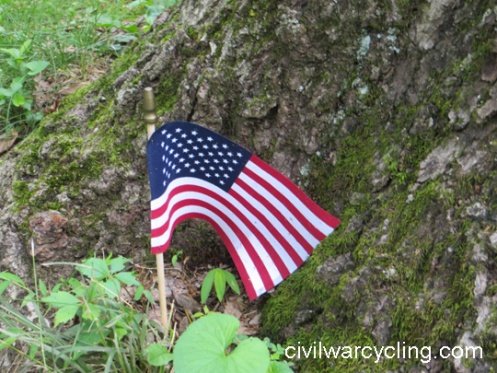
A flag at the base of a Gettysburg Witness Tree in the Culp’s Hill area
Second, Harry Pfanz and Scott Hartwig are well-known scholars and public historians. The only caveat that I raise is about the park map on the inside back cover. The map was accurate at the time of publication (1994) and its reprint in 2006, but it has one major flaw today. In 2008, a new visitor center opened and its location changed.
In my opinion, that flaw is easily remedied. Simply download an up-to-date park map from the National Park Service. Or grab a free map from a kiosk at the Gettysburg National Park Museum and Visitor Center.
Wrap-Up
One history book to prepare for your bicycle trip to Gettysburg? Yes, if history is your primary focus, I recommend Harry Pfanz’s book, The Battle of Gettysburg. For bicyclists who want to study the battle prior to arriving at Gettysburg National Military Park, this book is not only a pleasant read, but it is historically accurate. For more in-depth study, please consider perusing my “Gettysburg Reading Recommendations.” For reading recommendations specific to bicycling logistics, please stay tuned for future posts to the Civil War Cycling website.
I begin with a personal comment: My interest in American Civil War history accelerated after my kids grew up. I like to think it’s because I started to have more time to read and reflect. Truthfully, though, that wasn’t it. In this blog post, I offer three common reasons why you think you cannot learn history (and how to fix it).
3 Common Reasons Why You Think You Cannot Learn History (And How to Fix It)
Adult learners are responsible for their own learning. That’s the theme here. And it ties together the three reasons why you think you cannot learn history, which we outline below.
On the downside, it means that if we don’t choose to have fun, or to find relevance and meaning, then we won’t. Period. Your choice.
On the upside, it means that you are free to learn whatever you want, however you want, for whatever purpose that you want. It’s a free choice.
1. You cannot imagine that history could be fun.
History may not have been fun in school, so how could it be fun now? I confess, I once thought that way. Looking back, I have only a handful of memories about learning history in a classroom setting. I enjoyed studying history when I had an opportunity to research my own topic, draw my own picture, or go on a field trip. Unfortunately, those types of fun experiences were more the exception than the rule.
Sorry, but this doesn’t look like fun to me!
Beyond some isolated experiences, I could not imagine that history could be fun. After all, what’s so fun about listening to Mr. McCreary bang his wooden yardstick against a dark oak podium whenever he sensed that we had tuned him out? We were supposed to be learning American History, but from my perspective as a ninth-grade girl, we were being forced to memorize the same things that we had to memorize in elementary school. Never mind that I couldn’t remember any of that. Not fun.
Okay, now, lest you think I was a poor student, I wasn’t. I was the valedictorian of my high school class. And I hated history, because it was boring. Or so I thought then. I did not know that history could be fun. To me, American history was just another subject outlined in white chalk on a blackboard.
How to Have Fun Learning History
If you have visited even one page of the Civil War Cycling website, you won’t be surprised that I propose the following remedy. Admittedly, it’s only one remedy among many good ones, but you might like it the best:
Explore historical sites on a bicycle! U.S. national military parks offer an awesome opportunity to have fun pedaling around and finding things to study, read, or experience.
Honestly, I don’t know that there is any adequate substitute for physically visiting a historic site. Bike it, walk it, drive it. Something!
2. You cannot see yourself as part of the story.
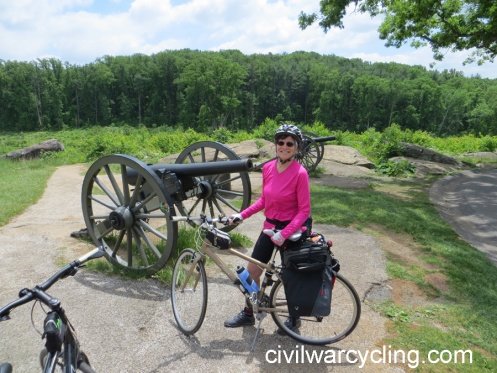
I wish that cannon wasn’t pointed at my head! Devil’s Den, Gettysburg, 2014. Click to read about the 4 best kept secrets about bicycling battlefields.
The second reason why you think you cannot learn history is that you cannot see yourself as part of the story. And in that case…
…it is hard to care. We want what we learn to be relevant to our lives.
If on a personal level the historical relevance or meaning is not immediately obvious, well then, we have work to do. But of course, we must want to work and want to learn. That’s a lot of preconditions. They can be big obstacles to overcome.
All this begs the question: Aside from serious goal-setting and traditional study, how can we see ourselves as part of a battlefield story?
How to Feel Part of the Story
In my experience, many women have a hard time even wanting to figure out how their own individual stories fit into a 19th century battlefield narrative. I’ve been one of those women. I just don’t relate to histories filled with military jargon and preoccupied with military maneuvers. I never felt like I was getting the whole story. Most certainly, I could not imagine myself being in the story.
At the risk of your noticing that I am repeating myself, I started feeling part of the story when I started to tour historic sites. In my opinion, the U.S. National Park Service has done a tremendous job highlighting the Civil War Era experiences of our broad and diverse population. The story includes women, children, citizens, African Americans, and European immigrants.
In our national parks, we can learn with our bodies and we can learn with our minds…
Learning With Your Body
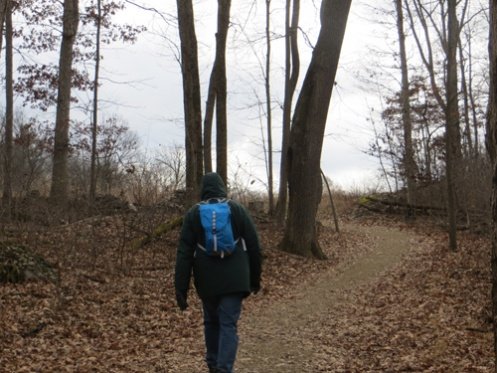
Sometimes bicyclists hike! The trek up Big Round Top, Gettysburg, on New Year’s Day 2016.
In a bicycling blog, it is no surprise that we focus on bicycle touring. A bicyclist enjoys a visceral experience of history while touring a national military park. A bicyclist uses his or her body to learn. We may not always understand exactly what we are learning, but we feel part of the story nevertheless.
For a deeper explanation, please see my post, 4 Best Kept Secrets About Bicycling Battlefields, where I describe how bicyclists experience in their bodies the historic significance of battlefield hills, fields, woods, and streams.
Learning With Your Mind
Of course, it’s also good to use our minds. While touring a battlefield, bring a history book that describes not only the actions of soldiers, but the actions of citizens and the impact of the battle on the town and nation. For some ideas on what to read, please see these my Civil War Cycling pages:Civil War Reading Recommendations or Gettysburg Reading Recommendations.
3. You were taught history as a long series of disconnected facts.
In the United States, this is a common complaint about history — that it is a long series of facts to memorize. It’s like a jumble of puzzle pieces that are never assembled into a meaningful picture.
Adults sometimes think that they cannot learn history, because they could not learn it in the past. Really good students may have learned it well enough to get an ‘A’ on a test, but that knowledge quickly disappeared.
The third reason why you think you cannot learn history is that you have not found a way that works for you. Sometimes, it feels like a Catch-22: To understand a theme, you need to know some facts; but the more facts that you know, the harder it can be to find a theme.
How to Discern Meaning in the Story
If you want to move beyond a mind-numbing catalog of facts and figures, I recommend that you start with a thematic book. For example, if you are interested in the Battle of Gettysburg, why not start with MacKinlay Kantor’s highly acclaimed book, Gettysburg? (For a review, please see: Simplest Ever Introduction to Gettysburg – Book Recommendation.)
Wrap-Up – Why You Think You Cannot Learn History
I offered three reasons why you think you cannot learn history, but there are probably many more. In the end, you are the only one who knows for you. The question is whether you want to take the next step. Do you want to have fun learning? And do you want your education to be relevant to your life? What about meaningful learning?
It’s up to you. For me, I found all of that and more on a bicycle.
Sometimes, the best books are written for kids but read by adults. My top pick for the simplest ever introduction to Gettysburg goes to MacKinlay Kantor. Originally written in 1952, this little classic for middle-school children survives as an accurate, high-level summary of the Battle of Gettysburg. As a former teacher and life-long student, I get really excited when I find a good, clear, and simply written book that appeals to a very wide audience of readers. And so, it is my pleasure to introduce:
Kantor, MacKinlay. Gettysburg. New York: Landmark Books, 1952, 1980.
The Simplest Ever Introduction to Gettysburg – A Book Recommendation
Why is the Kantor book “the simplest ever introduction to Gettysburg”? Answering that question is the purpose of this post. If you would like to review your other options, Civil War Cycling’s annotated bibliography on the Battle of Gettysburg contains a list of my favorite books. Not surprisingly, the Kantor book is on that list.
As an aside, please note that if you purchase the Kantor book through my Amazon Affiliate link, then this website may receive compensation from Amazon. My review is independent and my opinions my own, however.
I recommend MacKinlay Kantor’s book, Gettysburg, for several reasons. Here are three:
First, it reads like a novel.
Gettysburg reads like a novel without compromising historical accuracy. That is to say, Kantor wrote a book that remains accurate today, decades after its first publication. And if you find mistakes in the book, they are minor and pose little risk of throwing you off-track.
Kantor tells the battle story in chronological order, but without introducing mind-numbing details. That’s partly what makes it novel-like. Although he recounts details at a high level, he includes the main actor’s names and briefly describes their contribution to the battle. Kantor also weaves short, human interest stories into his narrative. And he includes the perspective of Gettysburg citizens and youth alike.
In other words, Gettysburg reads like a novel that happens to be “true.” … Maybe that’s what history is all about?!
In fact, Kantor’s descriptions are so clear that the text can stand on its own. Three basic black-and-white maps help the reader to understand the story, but their use is not essential. This feature makes the Kantor book very appealing: The words make sense on their own, which means that the reader can follow the narrative without having to look-up information elsewhere. That’s what a novel does.
Surprisingly, Gettysburg does not offer any photos. After all, it is marketed as a children’s book. And yet the lack of photos does not hurt the book’s ability to describe the Battle of Gettysburg in an understandable way.
Second, it is short and sweet.
The book measures 5″ x 7.5″ and is about one-quarter-inch thick. At 149 pages, most adults can read this book within a couple hours.
Third, it is a springboard for more learning.
I am guessing that most adults drawn to Kantor’s book have had a frustrating experience trying to understand the Battle of Gettysburg. Repeatedly frustrated, even.
If my guess is correct, then I share that same frustration. In my opinion, for example, many books and tour guides swamp new students with numbers, jargon, times, names, places, and other things. This is not helpful; often, it is a blow to peoples’ self-confidence. Ordinary people generally want to learn the basics without having to wade through volumes of detail.
In my opinion, Kantor’s book is the near perfect springboard for adults who want to learn more, but want a smoothly paved path to get there.


 Unfortunately, this little gem is difficult to find if you don’t know where to look. Your best bet is to buy through an