Category: Bicycling U.S. Civil War Battlefields

  • 5 Tips for Planning a Great Civil War Bicycling Adventure

    5 Tips for Planning a Great Civil War Bicycling Adventure

    Do you need some help with your U.S. bicycle touring plans? Here are five tips for planning a great Civil War bicycling adventure. Over the years, I have learned that “common sense” wasn’t so common (for me) when I first started touring U.S. military parks.

    In this post, I abstract the details of planning particular tours — to specific battlefields — into five high-level points. I got to these five points not by theorizing, but by planning and riding. I started from my personal experience and worked backwards. These are my “lessons learned” about planning a great Civil War bicycling adventure. I hope that they help you.

    Bicycling Gettysburg and Antietam

    I begin with an example — two different battlefields, Gettysburg and Antietam.

    Two Battlefields

    Gettysburg National Military Park is in Gettysburg, Pennsylvania. It is the site of the deadliest (three day) battle in American history, where on July 1-3, 1863, over 51,000 men were killed, wounded, or missing at the Battle of Gettysburg.

    Antietam National Battlefield is in Sharpsburg, Maryland, a rural mountain town near Antietam Creek. It is the site of the deadliest single day in American history, where on September 17, 1862, over 22,000 men were killed, wounded, or missing at the Battle of Antietam.

    Two Bicycle Tours

    This summer, I will bicycle the Gettysburg and Antietam battlefields. I’ve bicycled Gettysburg so many times that “planning” is a habit like packing for any trip. In other words, it has become routine and not much different from packing a suitcase to visit family.

    But Antietam is a different story. Although I have toured Antietam National Battlefield several times, this will be my first bicycle trip to Sharpsburg, Maryland.

    Similarities and Differences

    Planning a trip to Antietam is different from planning a trip to Gettysburg. Sure, there is significant planning overlap — like selecting a bicycle, packing and carrying food, and selecting a bicycle-friendly hotel — but there are many significant differences, too.

    Most notably, Sharpsburg is about thirteen miles (via the C&O Canal) from Harper’s Ferry West Virginia, which opens up the possibility of a multi-town tour. Gettysburg National Military Park, on the other hand, is about twice the size of Antietam National Battlefield and easily supports multi-day tours in this one town.

    In my opinion, multi-town tours are inherently challenging to plan. That’s because I am a recreational bicyclist, not a performance road bicyclist. I try to avoid major roads, and bicycling distance is not a goal. My goal is to have fun learning U.S. history on a bicycle and to do that safely.

    Finding Higher-Level Commonality

    Rather than allow the differences between each U.S. military park result in totally different approaches to bicycle tour planning, I recommend a different approach:

    Research, research, research … before you make travel commitments, before you start pedaling, before you travel to your battlefield.

    5 Tips for Planning a Great Civil War Bicycling Adventure

    1. Beef-up your history knowledge with some pre-trip reading.

    Please don’t postpone all of your learning until your arrival at a U.S. military park. This might work for passive tourists who rely on tour guides to spoon-feed them information and entertainment. But if you are planning a great Civil War bicycling adventure, you are in-charge.

    I recommend that you beef-up your history knowledge with some pre-trip reading. Why?

    So that you will know …

    • Where to visit (and why)
    • How to get there
    • What to look for (and what it means)

    These annotated bibliographies are good places to start:

    2. Decide what you’d like to see or learn on your trip.

    Of course, you will want to be flexible and open to new, unplanned experiences. After all, that’s one of the joys of bicycling — you can explore and discover things freely, however you want.

    On the other hand, it’s easy to feel paralyzed by your options. If everything interests you, then you risk feeling disappointed in the end when you cover “everything” superficially and nothing deeply. … And that one thing that you wanted to see? You didn’t see it.

    One way to handle these conflicting feelings is to set aside a block of time to learn or do something very specific. Examples include:

    • “Collecting” photographs on a particular topic (e.g., all equestrian monuments)
    • Finding monuments associated with a particular battlefield event
    • Finding a particular battlefield location, rock carving or witness tree
    • Visiting a memorial or marker that celebrates your home state

    These Civil War Cycling links might spark some ideas:

    3. Make decisions about equipment, transportation, and lodging.

    The need for logistical planning is obvious. You would do this for any vacation.

    And fortunately, the rules-of-thumb for making decisions about equipment, transportation, and lodging for bicycling a U.S. Civil War battlefield do not vary from park to park. I regularly write on this topic. Please see Civil War Cycling’s Blog Archive.

    4. Plan the specifics of your bicycle route (which impacts food, water, and clothing choices).

    There are two ways to plan a bicycle route. In that respect, planning a great Civil War bicycling adventure is no different.

    The first way is to plan by trial-and-error. Through time, you discover what maps are accurate (and what not); what roads offer the best ride; which circuits take how long; which parts of the battlefield offer the most dense learning opportunities; and more.
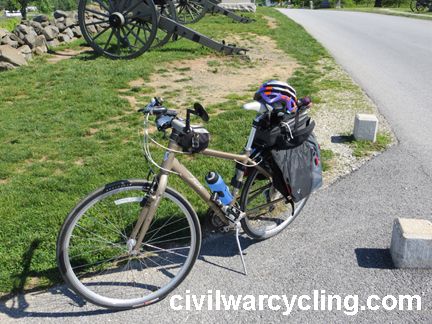
    planning a great Civil War bicycling adventure

    The second way is to design your bicycle route. You may change it as you go, but you will at least have a starting plan:

    • Collect as many maps of the area as you can find. Google and Amazon are great resources.
    • Try to plan routes that are circuits (loops) so that you can cover twice as much new ground.
    • Try to plan routes that avoid non-park roads.
    • Figure-out how and when you will use your car to transport your bicycle.
    • Research weather considerations and pack food, water, and clothing based on that.

    My Gettysburg bicycling plans started as trial-and-error. I could afford to do that, because I had the time and I lived within a few hours drive of the park. But Antietam is a little farther away for me, and I have a little less time available for travel. I need to plan.

    5. Check for NPS alerts, notices, and battlefield events.

    You don’t want to arrive at a U.S. military park and discover that your main point of interest is closed for renovation, a “prescribed burn,” or other maintenance work. Go to the home page for the National Park Service, search for your park, and look for a link to “alerts and conditions.” For example, as of this writing, the “Alerts & Conditions” page for Antietam National Battlefield says “No alerts at this time.”

    Wrap-Up

    Pre-trip planning is the key to a safe, educational, and enjoyable bicycle tour. Of course, flexibility and humor are important, but if you omit the planning step you may laugh straight through a comedy of errors that at best, reduce your learning opportunities, and at worst, endanger your safety on the road.

    I recommend that you plan to have fun and have fun planning.

    Do you need help planning a great Civil War bicycling adventure? I hope that the five tips in this post help you. Good plans support safe, educational, and enjoyable bicycle tours. That’s the prize.

  • 3 Considerations for Selecting the Best Bicycle for Touring Battlefields

    3 Considerations for Selecting the Best Bicycle for Touring Battlefields

    What is the best bicycle for touring battlefields? It’s easy to over-complicate not only the question but the answer. In today’s post, we outline how simple it is to select a bicycle for day rides through U.S. military parks.

    What is the Best Bicycle for Touring Battlefields?

    Recently, I blogged about packing and carrying food for day-long bicycling adventures touring U.S. military parks. I offered a few basic tips and explained how it’s actually fairly easy to plan what you will need to eat and drink for a day ride.

    The same principle applies to selecting a bicycle. There are many different types of bicycles, but only a couple types that you may want to avoid. Even if you select poorly, however, there’s always a path forward — especially if the you are healthy and fit.

    Consider 3 criteria to select the “best” bicycle for touring battlefields:

    1 – Pick a Bicycle That Fits Your Body

    First of all, the best bicycle for touring battlefields is one that fits your body. This is important for safety reasons, but also for overall enjoyment of your historical tour.

    It’s common sense: Make sure your bicycle is designed for your body weight and that it can be adjusted for your height. If you rent a bicycle for your tour, any good rental shop will know how to help you to select a bicycle that fits. On the other hand, if you want to buy a bicycle, go to a reputable bicycle shop and they will help you more than this blog post possibly can.

    Simple.

    2 – Pick a Bicycle That Is In Good Repair

    Second, the best bicycle for touring battlefields is one that isn’t broken or about to break. This is obvious, of course, but it advances my point that selecting a bicycle for a day-ride is not complicated.

    You don’t need to be a bicycle mechanic to know whether your bicycle changes gears smoothly; whether the pedals rotate and the tires roll; or whether the steering column works. And common sense applies if the chain looks rusty, spokes are broken, or someone put duct tape on the tires.

    Even so, if you are renting a bicycle from a reputable dealer, the staff will have inspected the bicycle before renting it to you. And if you own your bicycle, hopefully you have existing maintenance habits that keep your bicycle in good repair. (If not, you can always bring your bicycle to a shop for an inspection and “tune up.”)

    Simple.

    3 – Pick a Bicycle Suitable for Park Roadways

    Finally, our third consideration is specific to bicycling U.S. military parks, where the roads have similar construction, traffic, and geography. U.S. national military park roads are typically paved, and they are designed for slow moving (25 mph) motor vehicle traffic. The roads can be hilly but flat stretches may be more the norm.

    With that description in mind, I recommend that you avoid two types of bicycles, which I describe below.

    Avoid Cruisers

    First, “cruiser” bicycles work well for leisurely, recreational rides on mostly flat surfaces. They tend to require you to sit upright for a comfortable, single-speed ride over relatively short distances. This is why “cruiser” bicycles have the alternative name, “beach” bikes. You can safely enjoy touring a U.S. military park on a well-maintained and properly fitting “cruiser” bicycle, but please know that such a setup is more physically challenging. If you are not in great athletic shape, you will probably need to walk your bicycle up several hills. The extra work required to pedal a cruiser for long distances and up and down hills is why I do not recommend them for bicycling through U.S. military parks.

    Avoid Old, Heavy Mountain Bikes

    Second, old “mountain” bicycles that do not have modern gearing systems tend to be heavy and therefore more of a challenge to climb hills. If you are up for the challenge, there is nothing unsafe or wrong about selecting an old, heavy “mountain” bicycle. It’s all a matter of knowing what you want out of a ride and whether your body can handle it. Again, because the weight of these bicycles may introduce unnecessary physical challenges to your battlefield tour, I do not recommend them.

    Just Pick Something and Ride!

    With cruisers and old mountain bicycles off the list, you don’t need to know the finer points on the differences between road, hybrid, touring, and lightweight mountain bicycles. Just pick something that you like and ride. It’s hard to imagine that you will have any regrets.

    Of course, you can do more research if you want. For example, if you will be renting a bicycle, you might want to let the sales associate know how many hours you anticipate riding; this may influence their recommendation. In any case, the sales associate will know the park terrain and likely will only offer a bicycle rental that makes sense for a day-ride.

    Wrap-Up

    Hopefully, this post took some of the mystery out of selecting the best bicycle for touring battlefields. The “best” bicycle is simply one that:

    1. Fits your body
    2. Is in good repair
    3. Is designed for day-rides on paved but possibly hilly roads

    Simple.

  • The Ultimate Guide for Packing and Carrying Food to Bicycle a U.S. Military Park

    The Ultimate Guide for Packing and Carrying Food to Bicycle a U.S. Military Park

    What food should you pack for a day-long bicycle ride, and how much water do you need? My answer is that a little common sense goes a long way, especially for day-trips through U.S. military parks. The goal is to select healthy, hardy, and refreshing foods, and to pack plenty of water. In this post, I offer one bicyclist’s opinion about packing and carrying food to bicycle a battlefield park.

    The Ultimate Guide for Packing and Carrying Food to Bicycle a U.S. Military Park

    What to Pack?

    Of course, your health is your responsibility, which means that you should vet anything that I suggest with your doctor and your own unique circumstances. For example, nuts are a great source of protein and healthy fats, but not if you are allergic to them!

    My intent is simply to share my opinions on what generally works for most people. In the end, packing and carrying food to bicycle a U.S. military park is a set of personal decisions that are based on health, fitness, and preferences.

    Prefer Hardy and Healthy Foods

    For day trips, I usually pack an assortment of fruits, vegetables, hard breads or crackers, nuts, and hard cheeses. The fruits not only offer extra hydration, but they are refreshingly sweet. The other foods offer substance for hungry bicyclists who need an energy boost:

    • Grapes, apples, pears
    • Carrots, celery
    • Bagels with nut spread
    • Crackers or maybe chips
    • Peanuts, almonds, cashews
    • Raisins, dried berries
    • Dates, figs
    • Hard cheeses (like cheddar)

    Sometimes, I also pack junk food, like potato chips, but these are the exception rather than the rule. In the spring and fall, I also enjoy sweet peppers and cucumbers, but these tend not to hold-up too well in hot weather.

    Avoid Fragile Foods

    In the summer, I highly recommend that you avoid packing fragile foods like raspberries, blackberries, mayonnaise-based sandwich spreads, or chocolate. Those foods often “melt” in the heat; usually still edible, these foods are nonetheless not nearly as palatable as when you first packed them. I’ve learned that lesson the hard-way (on more than one occasion), so I guess I’m a slow-learner.

    Bananas are my favorite fruit, but I have stopped packing them because they get bruised or turn brown while I ride. Your mileage may vary.

    How to Pack?

    You will need plenty of ziploc baggies and at least one plastic trash bag to hold your garbage. I find it very handy to load ziploc baggies with serving-size portions. Since you will always need to carry your trash out of the park, I recommend bringing a small, dedicated trash bag so that you can keep your garbage separate from your food.

    How to Carry?

    packing and carrying food to bicycle
    This bike has front and rear panniers.

    Once your food is in baggies, the next step is to figure out how to carry it. I prefer to use lightweight panniers, which are bags that you attach to your bicycle. If this is not an option for you — because, for example, you are renting a bicycle — a lightweight student backpack or fanny back is a workable solution.

    For shorter tours, the pockets of a bicycling jersey or lightweight jacket might work well for you. It’s all a matter of personal preference. There is no right or wrong way to pack — just differing levels of convenience.

    That’s it for food recommendations. As you can see, packing and carrying food to bicycle a U.S. military park does not require much effort, once you know the basics.

    What about Water?

    Remember,  historical touring involves lots of breaks and opportunities to rest and study. That’s why I think that having enough water is far more important than having enough food.

    But how much water? In the summer, I pack and carry five 16-ounce bottles of water per thirty miles of riding. I offer this number only as a reference point, as you must make this decision for yourself, perhaps by talking with a sports nutritionist or your doctor. In any case, I recommend that you have contingency plans for needing more water than you packed.

    First, before starting your ride, research the location of all public restrooms and water faucets in the park. If you are riding off-season, please also research which facilities might be locked or turned-off. Second, carry a few crisp one-dollar bills in the event that you want to bicycle to a commercial area to use outdoor vending machines.

    There are many more ways to carry water. You can do like I do, which is to pack it in the same way that you pack your food. Alternatively, you could use a backpack that contains a tube hydration system. I’ve never tried a hydration system, because it seems like too much effort, but I know people who like to be able to safely drink while bicycling.

    Wrap-Up

    With respect to food and water, planning a bicycle tour of U.S. national military is not complicated. Packing and carrying food to bicycle takes only a little forethought:

    • Remember to pack hardy, healthy foods and plenty of water
    • Know where you can get more water if you need it
    • Carry a fully charged cell phone in case of emergency

    Even when I have planned poorly, I could figure things out. So can you!

  • Memorial Day and a New Burst of Freedom – A Bicyclist’s Perspective

    Memorial Day and a New Burst of Freedom – A Bicyclist’s Perspective

    In anticipation of Memorial Day, today’s post is about my experience bicycling Culp’s Hill in Gettysburg National Military Park. For me, battlefield bicycling ignites a “new burst of freedom” (a play on President Lincoln’s words) that draws inspiration from the sacrifice of our veterans, living and dead. First, though, an admission. I struggle to find words that explain my personal opinion:

    Bicycling historians experience in our bodies the freedom won on the battlefield. In other words, the bodily experience of bicycling a U.S. Civil War battlefield is a celebration of personal and civic freedom.

    That’s about as succinct as I can say it, but the words sound so — what word should I use? — patriotic? profound? hollow? uppity? fake? naive? obvious? true? Nevertheless, the words capture how I feel.

    In this post, perhaps the best I can do is to run with those two sentences; add some photos; and mix-in a few paragraphs laced with words that connote sweat, grime, gusty breezes, and stinging heat. … and gratitude! Gratitude for the freedom to ride where I choose, how I choose, and with whom I choose.

    Memorial Day – A Bicyclist’s Perspective

    On Memorial Day, we remember and honor our military men and women who have died in service of our country. I remember them every time I bicycle Gettysburg National Military Park. And for me, there is no greater example of a liberating ride than pedaling hard up Culp’s Hill and then flying down so fast that it’s really wise to tap your brakes at least a little. The wind is so strong against my ears that I can only hear its roar. The wind gives extra meaning to the phrase, “new burst of freedom.”

    The above photos hint at the the beauty of Culp’s Hill, but it may not be obvious what an awesome ride it offers to bicyclists. Frankly, I cannot give up this fast, thrilling ride for the idea of stopping to snap photos. And even if I did, you would really need a video recording to understand the thrill.

    Pedaling up the hill along Slocum Avenue is another matter entirely. Even though it is a tree-lined road, in the summer the pavement is dreadfully hot. I will jump at any excuse to sit on a rock and enjoy a juicy apple. I don’t mind mixing sweaty palms with sticky apple juices, because I have a warm but wet washcloth in my panniers. And I am 100-percent sure that I am fortunate not to have been a soldier fighting on this steep hill.

    A New Burst of Freedom on a Bicycle

    When I write about a new burst of freedom, I am hinting at the physical experience of bicycling up and down hills — or suddenly changing one’s speed. I like to write about a new “burst” of freedom as play-on-words that recalls these sentences from President Abraham Lincoln’s Gettysburg Address on November 19, 1863:

    … that we here highly resolve that these dead shall not have died in vain — that this nation, under God, shall have a new birth of freedom — and that government of the people, by the people, for the people, shall not perish from the earth.

    In one sense, of course, my words could be received as a trivialization of the meaning of the Battle of Gettysburg. That is not my intent. I am only suggesting that sometimes it’s the little things in life that are the biggest expression of virtue and gratitude. President Lincoln’s 272-word address to the nation might just be the best example of oratory simplicity. Ever. Me on the other hand, all I can do is bicycle. And experience a new burst of freedom.

    Where is Culp’s Hill?

    Culp’s Hill is less than one mile southeast of downtown Gettysburg. According to the United States Geological Survey, it stands at 629 feet MSL (Mean Sea Level). By contrast, nearby Cemetery Hill is 616 feet MSL. On July 2-3, 1863, the Union line extended from Culp’s Hill (its right flank), west and around Cemetery Hill, and then south along Cemetery Ridge to Little Round Top (649 feet MSL), which is about two miles from Culp’s Hill.

    Can you find Culp's Hill on this map?

    The bicyclist experiences these modest hills as short and steep ascents followed by great downhill bursts. The ride from the south end of Slocum Avenue (at Spangler’s Spring) to the summit of Culp’s Hill is a 0.8 miles climb with very little relief unless one takes a break to look at the many regimental monuments that line the park roadway. The ride down Slocum Avenue to Stevens’ Knoll (at the intersection of Slocum and Wainwright Avenues) is a quick 0.2 miles. I wish this “new burst of freedom” were longer, because it’s over in a jiffy.

    The Battle for Culp’s Hill

    Slocum Avenue is named after Union Maj. Gen. Henry W. Slocum (1827–94), commander of the 12th Corps, Army of the Potomac. The park avenue marks the approximate position of the Union battle line. This was the Union right flank on July 2-3, 1863, when Confederates attacked from the north and west, roughly from positions marked by modern-day E. Confederate Avenue.

    The fighting on Culp’s Hill was intense. The oldest Union general at Gettysburg, Brig. Gen. George S. Greene (1801–99), ordered his brigade to create earthen breastworks to hold the Confederates in check. The sixty-two-year-old former civil engineering instructor from West Point and his men in Slocum’s 12th Corps held the high ground for the duration of the Battle of Gettysburg. In 1907, a monument honoring Greene (by sculptor R. Hinton Perry) was dedicated at the top of Culp’s Hill, not far from the Observation Tower.

    The Ride Down from the Summit

    new burst of freedom
    View from the base of Culp’s Hill Observation Tower, before your ride down.

    Bottoming Out at the Knoll

    new burst of freedom
    View from the base of Culp’s Hill, near the end of your ride down.

    Why Does It Matter?

    Lincoln addressed a crowd of 15,000-20,000 people at the dedication ceremony for Soldiers’ National Cemetery in Gettysburg. Although the Gettysburg Address is not directly associated with Memorial Day, his words continue to explain for generations of Americans why it matters:

    The Gettysburg Address

    Four score and seven years ago our fathers brought forth on this continent, a new nation, conceived in Liberty, and dedicated to the proposition that all men are created equal.

    Now we are engaged in a great civil war, testing whether that nation, or any nation so conceived and so dedicated, can long endure. We are met on a great battle-field of that war. We have come to dedicate a portion of that field, as a final resting place for those who here gave their lives that that nation might live. It is altogether fitting and proper that we should do this.

    But, in a larger sense, we can not dedicate — we can not consecrate — we can not hallow — this ground. The brave men, living and dead — who struggled here, have consecrated it far above our poor power to add or detract. The world will little note, nor long remember what we say here, but it can never forget what they did here. It is for us the living, rather, to be dedicated here to the unfinished work which they who fought here have thus far so nobly advanced. It is rather for us to be here dedicated to the great task remaining before us—that from these honored dead we take increased devotion to that cause for which they gave the last full measure of devotion — that we here highly resolve that these dead shall not have died in vain — that this nation, under God, shall have a new birth of freedom — and that government of the people, by the people, for the people, shall not perish from the earth.

  • The Ultimate Guide to Selecting a Bicycle-Friendly Hotel

    The Ultimate Guide to Selecting a Bicycle-Friendly Hotel

    Bicycling historians know that hotel selection can make or break a trip. And it’s not about money. Money won’t necessarily buy you what you need. Fortunately, selecting a bicycle-friendly hotel is not complicated. Today, I offer a few tips based on my own experience.

    The Ultimate Guide to Selecting a Bicycle-Friendly Hotel

    I have bicycled Gettysburg National Military Park dozens of times. The first few times, I did “okay” selecting a hotel, but not great. I always enjoyed my trips, and yet I could have enjoyed them more if I had paid attention to the tips in this post about selecting a bicycle-friendly hotel.

    selecting a bicycle-friendly hotel

    What is a bicycle-friendly hotel?

    First and foremost, a bicycle-friendly hotel tries to accommodate the unique needs of a bicycling tourist. What exactly that means will vary from one person to the next, but minimally, you want a hotel whose guest policies are clear but flexible. Like any good relationship, the key is good communication backed by follow-through.

    Top 3 Considerations for Selecting a Bicycle-Friendly Hotel

    1. Bicycle Storage Options

    From a hotel management perspective, the bicycle is what makes a bicyclist different from other guests. Where can I store my bicycle, and how and when can I get to it?

    The storage question is important mostly because you will want to protect your bicycle from being stolen. If you will lock your bicycle on or in your car, where is the hotel parking lot and is that well lit and safe? Will the hotel allow you to wheel your bicycle into your room? Does the hotel offer a secure storage room in which you can keep your bicycle?

    I mention these questions, because you should not assume that a hotel can provide safe storage for your bicycle. For example, elegant inns with period furniture and carpeting may not want to risk allowing bicyclists to bring their bicycles indoors. On the other hand, large “budget” inns may have no issue whatsoever with your bringing your bicycle to your room, but will you have to carry it up three flights of outdoor stairs?

    Even though there are many questions to consider on the topic of bicycle storage, it’s really not as complicated as it sounds. Do a little research on the internet, make a phone call, and use your best judgement.

    2. Proximity to Park Roads

    With respect to bicycling U.S. national military parks, a bicycle-friendly hotel is a hotel that is a close and safe bicycle ride to battlefield. Each of us may have very different definitions of “safe,” but for me it means that if I need to ride on a public road, there is a bicycle lane or a wide shoulder. Safe roads are ones where motor vehicles can easily see bicyclists, and vice versa. (For more details, please see my post, My Top 3 Safety Mistakes While Bicycling Gettysburg.)

    selecting a bicycle-friendly hotel
    Comfort Suites Hotel on Baltimore Pike, Gettysburg

    Personally, I like to park my car in the hotel parking lot and leave it there. It’s so liberating not to have to hassle with a car trip before every bicycle ride, long or short. I use my car as “home base” for getting ready before a ride. It’s where I pump my tires, pack my panniers, and put on my helmet and gloves. So, if a hotel is within a safe riding distance from a battlefield, I am thrilled.

    3. Mutual Respect and Understanding

    When hotel staff and hotel guests share a mutual respect and understanding, all of your other bicycling needs will be met in much the same way as for other guests. Basically, bicycle-friendly hotels have all-around great customer service; and to enjoy that kind of service, it is important to be a great customer.

    Hotel Etiquette for Bicyclists

    This is common sense, but it bears mentioning:

    1. A bicyclist should take care not to track dirt or mud into the hotel. Take off your shoes and walk in your socks if you must.
    2. A bicyclist who is walking a bike indoors should always yield the elevator to other hotel guests. Some elevators are very small, and it’s not fair to other guests if you monopolize an entire elevator.
    3. Never ride your bicycle inside the hotel. Never, ever.

    Hotel Amenities that Bicyclists Especially Appreciate

    When you look for a hotel, be sure to read the online reviews. In addition to your normal preferences, you might want to give a fresh look at these amenities:

    1. Refrigerator – When I bicycle, I carry cold water, fruit, vegetables, and cheeses, all of which needs to be stored in a refrigerator the night before my morning ride.
    2. Microwave – If you plan on taking a long ride, you may want to come back to your hotel room, shower, and “crash.” But you’ll be hungry. If you pack some microwavable meals (and maybe some beers), you can have a relaxing evening without having to dress-up for a restaurant.
    3. All you can eat breakfast – Most hotels won’t mind if you take a piece of fruit and a bagel for a bicycling snack later in the morning.

    Wrap-Up

    Selecting a bicycle-friendly hotel is not difficult. The two most important things to consider are bicycle storage and proximity to the battlefield. If you plan ahead by knowing what to expect, you can find a way to make both of those considerations work for you. Lastly, please always respect hotel property, staff, and other guests.

    And that about sums it up!

  • My Top 3 Safety Mistakes While Bicycling Gettysburg

    My Top 3 Safety Mistakes While Bicycling Gettysburg

    A fun and educational bicycle tour is always a safe tour, which might sound obvious in theory, but in practice, it takes some effort. Today, I share my Top 3 safety mistakes while bicycling Gettysburg National Military Park. Fortunately, what you already know about bicycle safety is likely enough. On the other hand, the challenge is to remember to put your knowledge into practice.

    My Top 3 Safety Mistakes While Bicycling Gettysburg

    From a safety rules perspective, bicycling a U.S. Civil War battlefield is not a unique experience. That’s because — if you plan ahead to design circular routes that avoid non-park roads as much as possible — bicycling military parks can be far safer than road cycling. Even so, a bicyclist could make the following mistakes on any trip or tour.

    Here are my most memorable safety mistakes while bicycling Gettysburg:

    3. Forgetting to Turn on My Blinkies

    I’m not a road bicyclist. I know how to ride on roads safely, but I avoid them as much as I can. I prefer canal paths (no cars) and park roads (low speed limits). But still, of all the possible safety mistakes while bicycling Gettysburg, this is my most frequent mistake:

    safety mistakes while bicycling Gettysburg
    Parked for lunch. My blinkie is off.

    After riding for hours in bright sunlight — laaaa-la-laaa-la-laaa — I sometimes found myself on a winding, beautifully shaded, tree-lined road that is open to town commuter traffic. If you know Gettysburg, you know Hunt Avenue.

    That’s the moment that I think, “Shoot! I forgot to turn on my red blinkies!”

    Motor vehicle drivers do not always see bicyclists. Your safest bet is to help them by wearing bright clothing and having lights mounted on your bicycle. When the sun hides behind trees or when the weather starts to turn dark, bicyclists merge with the scenery. They are not so visible. Turn on your lights!

    I highly recommend that you turn on your back (red) and front (white) lights whenever using them would make you more visible to cars.

    2. Getting Pinned

    Twice, I have gotten myself pinned between bi-directional traffic. It’s the most dangerous situation that I have faced at Gettysburg, and there is absolutely no excuse for my mistake.

    Safety mistakes while bicycling Gettysburg do not have to happen. First, the bicyclist needs to know the particular safety issue. Second, the bicyclist needs to develop a particular safety habit. I describe both the issue and my new habit, below.

    What Does It Mean to Get Pinned?

    Typically, a pinned bicyclist is at the center line of a town road, preparing to turn left. Cars are coming toward you from the front, in their own lane. And cars are coming toward you from the back, in your lane. Unfortunately, many motorists do not understand that they are putting a bicyclist in danger when they (illegally) pass you on the right. If oncoming traffic picks-up just as a car passes the bicyclist on the right, the bicyclist is pinned. The bicyclist cannot turn left, cannot stop, and cannot continue straight. No matter where she looks, there are cars.

    Getting Pinned in Gettysburg

    safety mistakes while bicycling Gettysburg
    Entrance to Culp’s Hill Area from Baltimore Pike

    For me, the most difficult left turns are these:

    • From Baltimore Pike heading south, turning left into the Culp’s Hill area.
    • From Chambersburg Road heading north, turning left into the McPherson’s Woods area.

    The safety solution is simple. I have decided that I will always ride in the bicycle lane on the right side of the road all the way to my left turn. Then I stop, dismount, and walk my bicycle across the road.

    Fortunately, it is possible to bicycle Gettysburg National Military Park while riding mostly on park roads. For full-day bicycling adventures, however, you will need to ride on major roads for short distances, since these roads connect different parts of the battlefield. The Culp’s Hill entrance on Baltimore Pike is a perfect example.

    1. Not Knowing About One-Way Roads

    Safety-conscious bicyclists can handle being confused by a road network. They pull over and look at a map. Nonetheless, it helps familiarize yourself with the location of all one-way roads before starting your day’s ride.

    safety mistakes while bicycling Gettysburg
    GNMP Superintendent’s Compendium, 36 CFR 4.30(a)

    As of this writing in 2017, it is legal at Gettysburg National Military Park to bicycle against the flow of traffic on park roads. Even so, you will want to decide ahead of time whether you are comfortable with that style of riding. You will not want to feel forced to choose between adding an extra hour of bicycling (and riding with the flow of traffic) versus taking the most convenient road (but riding against the flow of traffic).

    Wrap-Up

    This article touched upon three bicycling safety topics. They happen to be the ones that I need most to remember. I hope that these “Top 3 Safety Mistakes While Bicycling Gettysburg” help you to think about bicycle safety as you plan your own historical tour.

  • 4 Best Kept Secrets About Bicycling Battlefields

    4 Best Kept Secrets About Bicycling Battlefields

    I surprise and confuse many people when I say this: Bicycling a U.S. military park is not only a real possibility, but with planning it can be a fun and safe educational adventure. In this blog post, I spill-the-beans and then suggest that we “follow the money” to understand the four best kept secrets about bicycling battlefields in the United States.

    Best Kept Secrets About Bicycling Battlefields

    I grew up about fifty miles south of Gettysburg, in what was then rural Maryland. Gettysburg was a favorite family destination for historical touring and camping. But we never thought about bicycling the battlefield. Since 2012, however, I have bicycled Gettysburg National Military Park dozens of times. After every trip, I feel renewed and grateful for the opportunity to ride freely, to learn freely, and to enjoy my day however I want.

    Best Kept Secret #4

    Bicyclists have easier access to park monuments and interpretive signs than is possible for tourists in motor vehicles.

    This point may sound obvious. On the other hand, the first time you experience how easy it is to glide your bicycle over to a grassy shoulder, hop-off, and then do whatever you want — read, study, admire a sculpture, enjoy the view, or drink some water — you will be grateful not to be an auto tourist.

    bicycling shiloh
    At the Hornet’s Nest, Shiloh National Military Park

    There is a place, of course, for auto tours. Over the decades, I have enjoyed many car and bus tours. I am the first to admit that on a hot summer day an air-conditioned car is a great relief. But on the downside, I am not breathing fresh air. Windows separate me and my camera from a beautiful landscape.For me, the biggest hassle of touring in a car is that I am limited in the number of stops that I will want to make. The limit is self-imposed: I get annoyed having to find a parking space, turn off the engine, get out of the car, decide whether to lock my doors (and where to put my keys), and then repeat the whole thing in reverse — over and over again.

    Here is the fourth in my list of secrets about bicycling battlefields:

    If you are healthy enough to ride a bicycle at the pace of your own choosing, and humble enough to walk your bicycle up a few hills, then bicycling Gettysburg National Military Park is definitely an option worth considering.

    Best Kept Secret #3

    Bicyclists experience in their bodies the historic significance of battlefield hills, fields, woods, and streams.

    This point may seem abstract. Let me put it this way: A bicyclist who is pedaling up Sykes Avenue to the top of Little Round Top (Gettysburg) feels strain in her legs and hips. Even in first gear, I huff and puff. I have doubts that I will make it to the top without having to walk my bicycle. Half the time, I walk the hill.

    View from Little Round Top
    View looking southwest toward Devil’s Den from Little Round Top, Gettysburg National Military Park

    Having experienced the steepness of that hill, a bicycling historian has a physical appreciation for the efforts of Union and Confederate soldiers who fought there on July 2, 1863. As I pedal to the top of Little Round Top, I am aware that men from Texas and Alabama tried several times to scale the hill from my right-rear (southeast) and that men from Maine repulsed them from my right-front (northeast).

    And of course, what goes up must come down! Gettysburg offers several small and large hills that offer a pleasant and invigorating downward ride — Little Round Top, Culp’s Hill, Oak Hill, and even the gentle decline of Seminary Ridge.

    Here is the third in my list of secrets about bicycling battlefields:

    If you really want to learn history, there is no substitute for physically visiting a historical site. And the more actively you engage your senses, the more likely you will understand and remember the significance of the historical event.

    Best Kept Secret #2

    Bicyclists exercise their own self-determination and confidence by planning their own educational experiences.

    Personally, I prefer to make my own decisions about what I learn and how and when. I probably got that way because I went to school for longer than most people. As a student, I tried to do everything that I was told to do. On the other hand, you may prefer the help of a licensed guide. The right way is whatever works for you.

    Gettysburg Bike Map Sample
    Sample Civil War Cycling Map Segment for Touring Gettysburg National Military Park

    Here is the second in my list of secrets about bicycling battlefields:
    Unless you live within an easy car ride of Gettysburg, bicycle touring requires some upfront planning. A bicyclist will need to decide ahead of time what Gettysburg sites or monuments to visit and why. This is so that the trip can be as fun and educational as possible in that time that you have available. For independent-minded people, the planning step is also fun!

    Best Kept Secret #1

    Bicyclists celebrate their freedom and independence without needing to spend a lot of money.

    Your biggest expense as a bicyclist touring a U.S. national military park is what you would expect of any vacation: transportation and lodging. If you do not already own a bicycle, you can rent one for the day. On a bicycle, food and water is no more expensive than packing a lunch for school or work.

    bicycling antietam
    A Visit to Antietam National Battlefield, Sharpsburg, Maryland

    Bicyclists who tour U.S. Civil War battlefields help boost the local economy with their tourist dollars. But spending money is not our primary focus. For example, when I ride through Gettysburg National Military Park, there are no souvenir shops, book stores, or restaurants. I am my own tour guide. The museum and visitor center may be miles away.

    In fairness, the National Park Service encourages tourists to enjoy fully the natural resources that it maintains and preserves as park land. My point is that you may not hear much about bicycling a U.S. national military park, partly because historical bicycling is not a big part of the tourism industry. …. And bicyclists like it that way!

  • Decoding a Complex Battlefield Story – Shifting Your Mental Gears on a Bicycle

    Decoding a Complex Battlefield Story – Shifting Your Mental Gears on a Bicycle

    When I learned to identify landmarks while bicycling U.S. Civil War sites, my mind exploded. I had found the key to decoding a complex battlefield story.  Today, I will tell you what I learned that was so amazingly helpful to my life-long passion to understand the Battle of Gettysburg.

    Hello! Welcome to Civil War Cycling.

    decoding a complex battlefield story
    Your Coach, Sue Thibodeau

    My name is Sue. I help people make U.S. history fun on a bicycle by providing educational tools and touring tips for planning safe and fun Civil War bicycling adventures. I am also an educator, technologist, and bicycling enthusiast.

    Today, the Civil War Cycling website launches with a story that explains why I think historical bicycle touring is the greatest thing since ziploc baggies. (I would say “since sliced bread,” but that might make me sound old, which maybe I am, but I’m not saying that.)

    The Need – Decoding a Complex Battlefield Story

    I have toured Gettysburg National Military Park at least fifty times. I camped in Gettysburg as a kid, honeymooned there as a young adult, and for over thirty years, I stopped for quick visits while driving south to visit family. In recent years, I have bicycled the park dozens of times.

    Okay, so now that we have established that I am mildly obsessed with Gettysburg, please allow one more confession. Until recently, only two educational resources ever truly helped me to understand the Battle of Gettysburg. First and foremost, I loved the (now closed) “Gettysburg Electric Map.” Second, there was the 1971 (no longer in print) souvenir guide by James A. Gross and Andre B. Collins entitled, “Gettysburg.”

    I consider this a confession, because I am not dumb. Instead, I am impatient with military jargon and stories that leave-out human beings. My impatience got in the way of learning even the things that I truly care about, like Gettysburg.

    Shifting Mental Gears on a Bicycle

    Fast forward to 2014. As I was gliding down Seminary Ridge (West Confederate Avenue) on my bicycle, I noticed that — about one mile beyond the fields on my left — I could see some tall monuments.

    This was my first memory of being aware of my physical relationship or orientation to the battlefield, which was of course constantly changing, because my bicycle was moving.

    Of course, I had always (perhaps mostly) knew where I was and maybe also where I was going. But until this 2014 experience, I never really thought about how my location on the battlefield influenced what I could see; how my body felt; and whether the experience could inform my understanding of the battlefield experience of the two armies that invaded this small town of 2,400 people in 1863.

    What is my point? Once I started to notice and then study Gettysburg geography and prominent (natural and physical) landmarks, the Battle of Gettysburg started to make a lot more sense to me. And it was fun. The entire learning experience became more of a puzzle, even a game. Even better, it was a game whose rules I could make and change as I pleased. Regardless, it was no longer necessary to listen to long lectures about military tactics, weaponry, and military organization. Although these topics are important, they do not light my intellectual fires.

    The Solution – Decoding a Complex Battlefield Story

    decoding a complex battlefield story
    The Vermont and Pennsylvania State Monuments in this photo are visible from Seminary Ridge, one mile to the west (left).

    So in the end, I decided to change my approach. First, I observe what natural and physical structures are located where. Then I try to figure-out its meaning. Inevitably, this technique introduces real, flesh-and-blood people into the battlefield story. It cannot be otherwise. And I also become part of the story, because my flushed, sweaty, and sometimes aching body remembers how hard it was to scale those hills, too.

    Check out this Gettysburg landscape photo essay …

    Decoding a complex battlefield story is fun when you are riding a bicycle, especially if you have a camera. In any case, please enjoy the following simple landscape photo essay on the topic of Pickett’s Charge (July 3, 1863). Please click here:

    Civil War Cycling